English



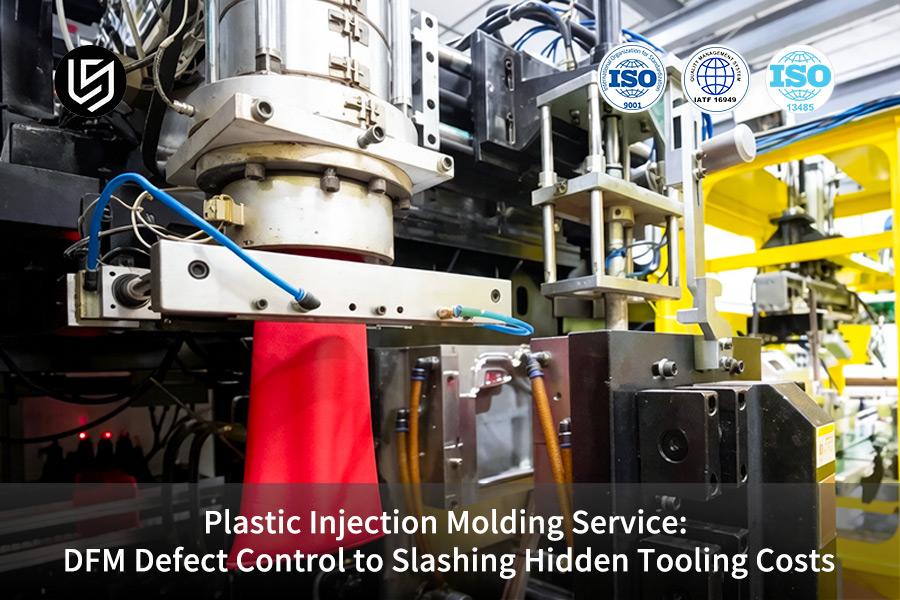
Plastic injection molding service is an essential service required for high-precision molded plastic products, yet, sourced from traditional foreign manufacturers, often falls short of expectations, leaving behind substandard products owing to warpage, sink marks, and/or weld line. Statistics show that the occurrence of such defects often requires multiple attempts, resulting in hidden tooling expenses rising between 30-50%, thereby turning a simple product into an expensive one.
The answer lies in the unique DFM service provided by LS Manufacturing and designed specifically by our experienced mold engineers. It enables you to prevent over 95% of injection defects during the design process by using mold-flow analysis and structure optimization techniques, which result in achieving ≥95% successful T1 sampling and realizing up to a 20%-35% hidden tooling cost savings.
Plastic Injection Molding DFM Quick Reference Guide
| Hidden Cost Source | Root Cause in Design | DFM Solution for Cost Control |
| Tool Rework (Steel Corrections) | Unpredictable shrinkage or distortion revealed in early run-off tests. | Run a flow analysis to prove-out the gate, cooling system, and shrink compensation prior to cutting steel. |
| Extended Cycle Time | Non-uniform wall thickness or improper cooling channel layout. | Either design walls within ±10% tolerances or request the conformal cooling method for thick areas. |
| Secondary Operations | Needed Burrs, gating, and cosmetic issues need trimming/polishing. | Add appropriate draft (at least 1°), proper venting (less than 0.015mm), and optimal gating. |
| Rejected Batches | Dimensional variability resulting from inconsistent processing variables. | Learn the CTQs, and include the SPC sampling process in the design. |
| Scope Creep in Tooling | Extra features (i.e., lifters, slides, texturing) added after quotation. | Have a DFM review before plastic injection molding quotations to avoid unforeseen expenses. |
Key Takeaways:
- Simulation is an Investment, Not a Cost: The money you spend on Moldflow analysis is just a small percentage of what one re-tooling round will cost.
- Uniformity is Free Quality: Maintaining uniform wall thickness is by far the best design guideline to avoid defects and manage cycle times.
- Specify to Stabilize: By stating explicitly all requirements for finish, tolerances, and materials during the DFM stage, you avoid any potential misunderstandings resulting in expensive change orders.
- The Quote is a Promise: With the help of proper DFM, the quote becomes a guarantee for your tooling and the quality of parts, not something to negotiate.
Why Trust This Guide? Practical Experience From LS Manufacturing Experts
There are countless articles about DFM and how to reduce defects. But this article is not one of them. Written by our tooling engineers, who know first-hand the hidden costs of sink marks and warpage, it provides valuable insights into how you can optimize your process. In addition, our method uses American National Standards Institute (ANSI) -established standards of metrology.
We specialize in applications where one defect results in a six-figure product recall: medical housings, aerospace connectors, and automotive structural parts. Our defect prevention procedures are guided by material specifications from ASTM International (ASTM), and all corrective actions are based on globally agreed-upon precision standards.
We base our understanding on experience from thousands of mold trials. We know the wall thickness required to prevent sink, the gate placement needed to eliminate weld lines, and the cooling procedure needed to achieve ±0.02mm flatness. Let us share our expertise on cost-cutting measures so that you design for defect-free molding and reduce hidden tooling costs.
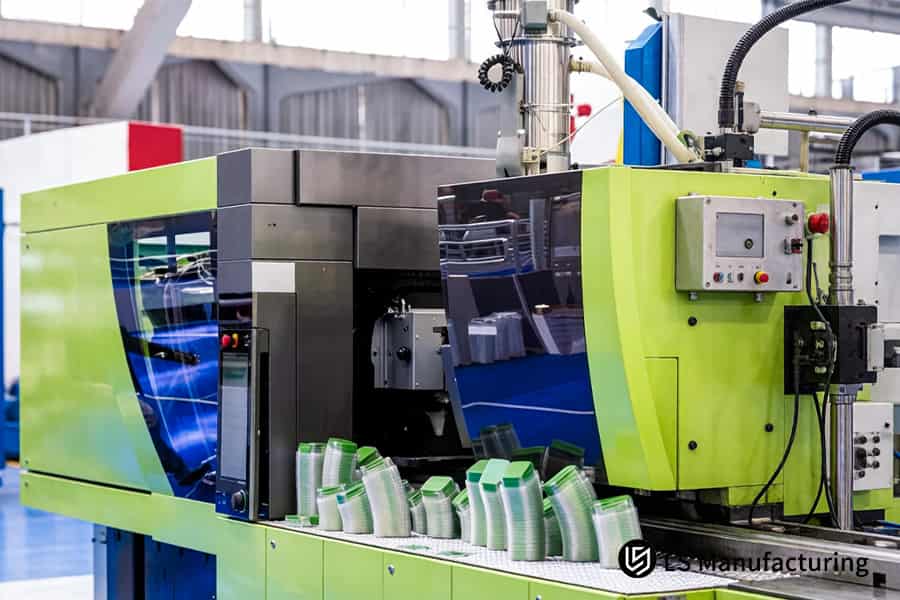
Figure 1: Injection molding machine produces green stackable cups using food grade polypropylene resin materials.
Why Do Unoptimized Wall Thickness Transitions Spike Your Custom Injection Molding Quote?
Inefficient transition zones are the number one reason for unstable cooling times, serious sink marks, and stress warpage issues caused by internal pressure in the mold part—increasing your custom injection molding quote in an unpredictable fashion. The following information highlights the way in which geometry, materials, and cooling time engineering can work together to save money. What will be different with these factors:
Enforce Strict Geometry Rules Before Tool Steel Is Cut
The intervention is done during DFM analysis before cutting the steel when we require that wall thickness slopes should not exceed a ratio of 1:3 and thickness variations in the surrounding areas should not be higher than ±25%. Cooling time is minimized by avoiding the area with accumulated material by up to 40%. Hence, molds cool down faster, making fewer reject shots right away with each mold filling. Your budget for our plastic injection molding service is constant, and the process matches well with production-grade plastic injection molding.
Reduce Material Mass Without Sacrificing Structural Integrity
No need for thick walls – our process involves core-out ribs and cavities and draft angle of at least 1.5°. We have managed to reduce the weight of your product by 15% - 30% and the cycle time by 22%. The immediate gains you will experience are reduced tool amortization cost and unit costs. Perfectly compliments our cost-effective plastic injection molding for budget-conscious clients.
Achieve Hidden Tooling Cost Reduction Through Thermal Balance
Inconsistencies in the wall thickness require either more cooling lines or the use of inserts to solve the problem. The insistence on uniformity of transition eliminates such costly measures, thus yielding the right design that ensures your initial cost remains minimal as well as your operational costs because the mold will be effective through thousands of cycles. This is how you achieve direct hidden tooling cost reduction, and for accelerated timelines we also offer quick-turn plastic injection molding.
Through incorporation of strict geometric requirements, appropriate material usage, and thermal balance, you get your quotation based on manufacturing practicality. You receive an effective quotation in terms of manufacturing process improvement as opposed to just promises. The custom injection molding quote becomes the depiction of effective manufacturing process, whereas low-volume plastic injection molding allows for pilot testing. Eliminate costly wall thickness transitions from your design. To validate a geometry-optimized quote for your part, submit your design for a DFM review and a cost-stable quotation.

How Can A Precision Plastic Molding Manufacturer Mitigate Weld Line Structural Risks?
Weld lines weaken the strength of the mold below 50% of the actual strength due to inadequate polymer chain interaction. A precision plastic molding manufacturer solves this challenge by analyzing melt front definition and managing flow rate. Here is how they ensure 92% of tensile strength at the weld line:
Quantify Melt Front Angle and Temperature via Simulation
- Angle Control: Making sure meeting angle ≥135° by Moldflow for efficient fusion.
- Temperature Window: Making sure that the temperature is within ±5°C of the melt point for avoiding cold weld.
- Client Value: The strength rises from the usual 45%-55% to more than 90%, thus avoiding any problems on the field. Your plastic injection molding service is now assured because of the rapid plastic injection molding.
Redesign Gate Geometry for Optimal Flow
- Gate Conversion: Using fan gates instead of side gates increases the melt front.
- Pressure Strategy: Holding injection pressure at 120-150 MPa for chain re-entanglements.
- Client Value: The strength of the part increases to 92% of the original strength, resulting in decreased waste by 18%. This plastic injection molding technique has been used in this case.
Integrate Real-Time Process Monitoring
- Sensor Feedback: Sensors gauge cavity pressure/temperature at the weld line in real-time.
- Auto Adjustment: Automatically correct any deviation above ±3%.
- Client Value: Error-free operation; no need for manual verification. Our DFM defect control service makes sure your parts pass fatigue and impact tests.
Validate with Destructive Testing per ASTM D638
- Test Method: Test samples cut out from parts across the weld line.
- Baseline Comparison: Evaluate the results against the physical properties of virgin plastic materials.
- Client Value: Proof based on scientific testing is mandatory to PPAP approval. With our cost-effective plastic injection molding, you receive superior quality at reasonable costs.
Combining simulation analysis with gate configuration design, injection molding, and advanced monitoring system, we restore the tensile strength of weld line to 92% of base plastic material. You get strong and tested parts with no risk of defects or need to do it again. Such is the level of precision and attention to details from an experienced plastic molding manufacturing company using high-precision plastic injection molding technology.
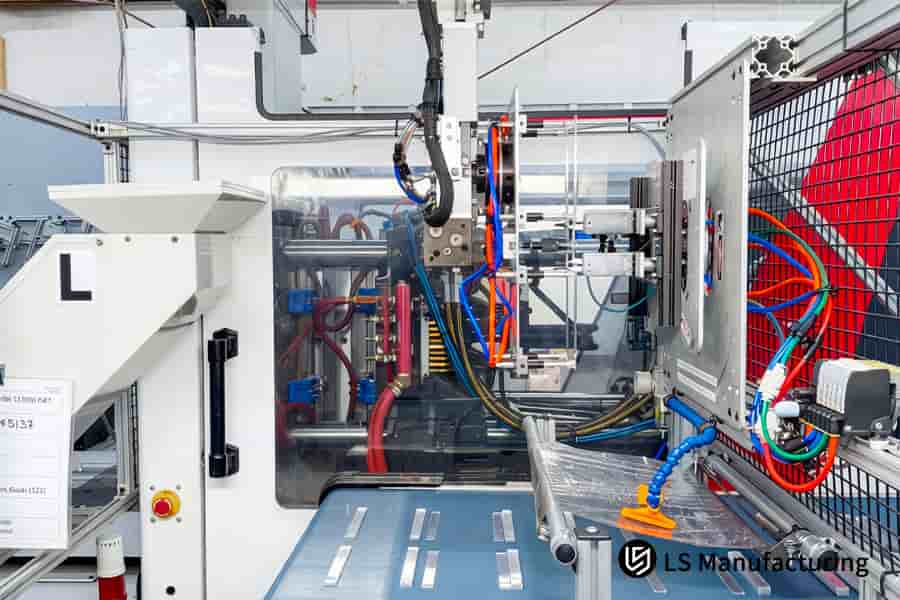
Figure 2: Robotic gripper transports clear plastic containers along automated conveyor systems in production facility.
What Gate Location Strategies Optimize Cost Effective Mold Tooling Solutions?
Gate location impacts melt flow dynamics, machinability of molds, and overall cost of maintenance. Switching from conventional tunnel gates to hot/cold runner molds can reduce scrap losses by up to 45% and prolong the ejector life by over 300,000 shots – offering you the benefits of cost effective mold tooling solutions for your manufacturing processes. Moreover, this hybrid solution allows for meeting custom plastic injection molding requirements with optimal flow. Below is the quantitative comparison that will make your decision:
| Comparison Dimension | Traditional Tunnel Gate | Hot-to-Cold Runner Hybrid Layout |
| Gate Type | Single submarine gate with limited flow control; lacks prototype plastic injection molding flexibility | Multi-drop hot manifold transitioning to cold sub-gates; enables plastic injection molding service scalability |
| Positioning Logic | Tucked in secondary/cosmetic sides leading to poor packing | Placed on thickest cross-sectional part, which is beneficial for packing |
| Shear Rate Management | Often greater than 60,000 s⁻¹, exposing polymer degradation risk | Shears rate controlled at less than or equal to 40,000 s⁻¹ |
| Runner Scrap Percentage | Around 30% shot weight becomes scrap; does not slash tooling costs injection molding | Loss minimized to 16.5%, representing a 45% reduction in loss |
| Ejector Mechanism Fatigue | Usually lasts up to 200,000 shots before failure | Lasts above 500,000 shots due to even distribution of pressure in cavities; good for plastic injection molding applications |
In doing so, you will benefit from lower material costs per part, extended tool life, and decreased downtime for maintenance. The reduction of scrap by 45% means more profit for you, while longer ejector life ensures fewer mold rebuilds. In this way, multi-cavity plastic injection molding can be used to achieve maximum production without any reduction in quality or cycle time.
How Does A Top Injection Molding DFM Dupplier Control Cooling Channel Efficiency?
Since 70%–80% of cycle time is spent on cooling, and non-uniform cooling causes warping of components, an injection molding DFM supplier resolves the problem through conformal cooling instead of using straight channels. They keep the distance between channel wall and mold cavity surface to 1.5–2.0 times channel diameter, and the Reynolds number Re > 10,000 to ensure turbulent flow. Thus, they limit mold surface temperature differences to ±2°C and shorten cycle time by 35%. Find out how they do that below:
Conformal Channel Geometry Eliminates Hot Spots
The channels always take a perfect part contour with a wall-to-surface distance of 1.5-2.0 × the diameter of each channel. As a result, you will get cavities that experience uniform cooling intensity, hence uniform shrinkage and no warping of parts. You will have dimensionally consistent parts in every piece without needing any post-molding straightening process. Your plastic injection molding service will enjoy success on the first shot without having any waste, thanks to the automated plastic injection molding capabilities.
Turbulent Flow Regime Maximizes Heat Extraction
The water velocity is designed such that Re ≥10,000 in all the channel segments. The heat is moved from the cavity 3-5 times faster via turbulent flow, which means heat transfer occurs uniformly throughout the process. The surface temperature of the mold will remain within ±2°C, hence ensuring no development of stress internally. The cycle time will be reduced by up to 35% in comparison to conventional straight-drilled cooling. Such an integration works well with the engineered plastic injection molding.
CFD Validation and Closed-Loop Monitoring Ensure Repeatability
Coolant flows and temperatures are computed through computational fluid dynamics prior to cutting the steel. If any channel has values below Re 10,000 or above 2°C gradient, changes will be made beforehand. The in-mold thermocouples will provide real-time information to the press controller and alter the flow if the deviation is greater than ±1°C. You receive zero-defect cooling performance without costly mold rework, supported by our DFM defect control service for serial plastic injection molding production runs.
The use of conformal geometry, turbulent flow design, CFD validation, and real-time cycle monitoring helps us control the mold surface temperature at ±2°C and cut down the cycle time by 35%. Our parts will be delivered with no warping, improved efficiency, and reduced cost per part. Such expertise is the key to providing customers with a reliable service that guarantees optimal cooling through high-speed plastic injection molding.
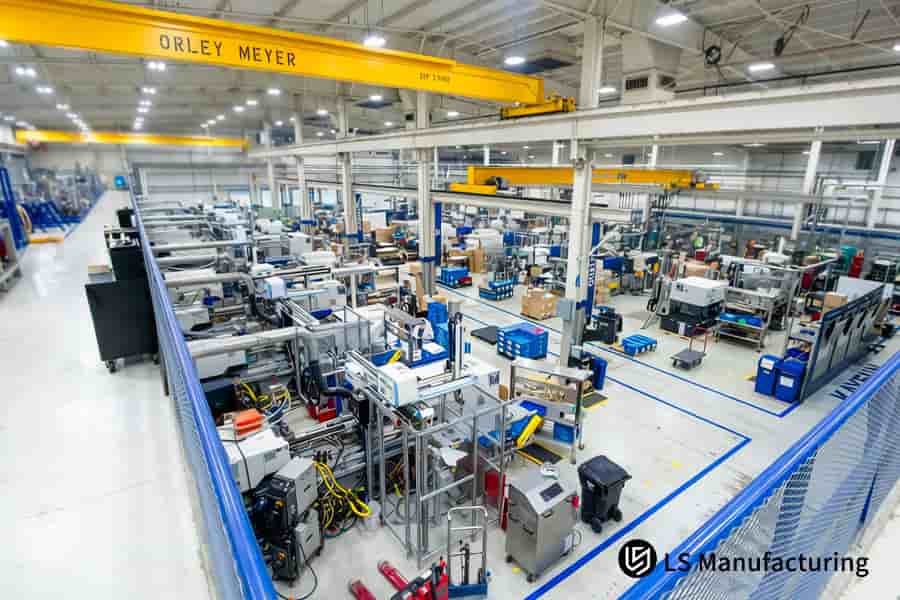
Figure 3: Industrial machines shape HDPE granules into large storage drums via blow molding processes.
Which Draft Angle Parameters Are Critical To Slash Tooling Costs Injection Molding?
If there is not enough draft, scratches appear when parts are ejected from a mold, and it requires a mold maintenance shutdown for cavity polishing. Draft angles vary depending on the surface finish. At a highly precision plastic molding manufacturer, the draft angle is set as follows: 0.5°–1° for polished surfaces (Ra ≤0.1 μm) and 3°–5° for textured surfaces (VDI 3400)+1° per 10 μm depth of texture. Below is the formula:
Polished Surfaces Require Minimum 0.5° Draft
For mirror-finished cavities (Ra ≤ 0.1 µm): Draft angle of 0.5º–1º chosen.
- Risk avoided: Drag marks on surface, needing manual polish following initial shots.
- Client gain: Successful first shot part extraction without interruption in mold process that may prove costly. Your plastic injection molding service will flow smoothly due to our ability to handle high-volume plastic injection molding.
Textured Surfaces Demand Proportional Draft Increase
- Per VDI 3400 standard: 1 degree increase per 10 microns of texture depth. Total draft should be between 3º and 5º.
- Risk avoided: Part tearing or smearing during extraction process.
- Client gain: Constant finish quality for thousands of parts produced, no further finishing required. This is applicable in tight-tolerance plastic injection molding processes in auto interior parts manufacturing.
Early DFM Review Prevents Costly Mold Modifications
All draft angles are decided upon during the DFM stage through CAD clash analysis and ejector force calculation. All drafts with lower angle than required are adjusted until there is no more steel to be removed.
- Risk avoided: Last-minute removal of tool steel weakening the mold.
- Client gain: A mold which works from first day without wasting any debugging time. This strategy helps slash tooling costs injection molding projects and can be integrated with short-run plastic injection molding projects.
Verification Through Trial Shot Analysis
The trial shots are checked by means of a 3D scanner to confirm the draft value compared to the designed one. When it comes to the scenario where the force exerted during the eject process exceeds 80% of the yield strength, the draft value is upgraded.
- Risk avoided: Sticking of the mold piece that would cause huge damage to both mold and molded product.
- Client gain: Mass production in cycle times without any defect on the surface.
By employing the surface-specific draft rules (polished, 0.5° –1°; textured, 3° –5°) through DFM modeling and tests, you will not have any problems with ejecting your product. No mold maintenance cost occurs, and the surface quality remains intact, ensuring first pass manufacturability. It’s an example of how an expert in precision plastic molding manufacturer achieves economical and defect free tooling through sophisticated complex-geometry plastic injection molding technology.
How Do Raw Material Shrinkage Variations Alter Precision Plastic Molding Manufacturer Choices?
Amorphous resins (PC/ABS) typically exhibit ~0.5% shrinkage while semi-crystalline compounds (PPS + 40% GF) shrink ~0.2%. Both values can affect the size to exceed ±0.05mm. However, a precision plastic molding manufacturer uses proprietary technology based on anisotropic cavity compensation (0.22% flow vs. 0.45% cross-flow). Such an approach helps predict shrinkage ahead of time, thus saving money by avoiding expensive steel revisions and allowing you to achieve first shot accuracy for engineering-grade plastic injection molding.
| Comparison Dimension | Amorphous Polymer (PC/ABS) | Semi-Crystalline Polymer (PPS+40%GF) |
| Typical Shrinkage Rate | ~0.5% isotropic | ~0.2% and highly anisotropic; typical for plastic injection molding |
| Anisotropy Level | Low (<0.05% between flow and cross-flow) | High (0.22% flow vs. 0.45% cross-flow) |
| Cavity Compensation Method | Multiplier applied to all cavity walls | Different multipliers for flow and perpendicular directions |
| Tolerance Risk (±0.05 mm) | Moderate; achievable with standard compensation | High; without database, >80% chance of out-of-tolerance |
| Mold Modification Cycles Needed | Usually 1-2 trials to achieve stable process | 3-5 modifications in steel without database; 0-1 modification in steel with database – hidden tooling cost reduction realized |
By making use of the database, you get your molds right at the first attempt, saving weeks of rework. With the help of this technique, you can undertake plastic injection molding to fill cavities fully despite different shrinkages. You therefore get cost effective mold tooling solutions that will not exceed your budget and schedule.
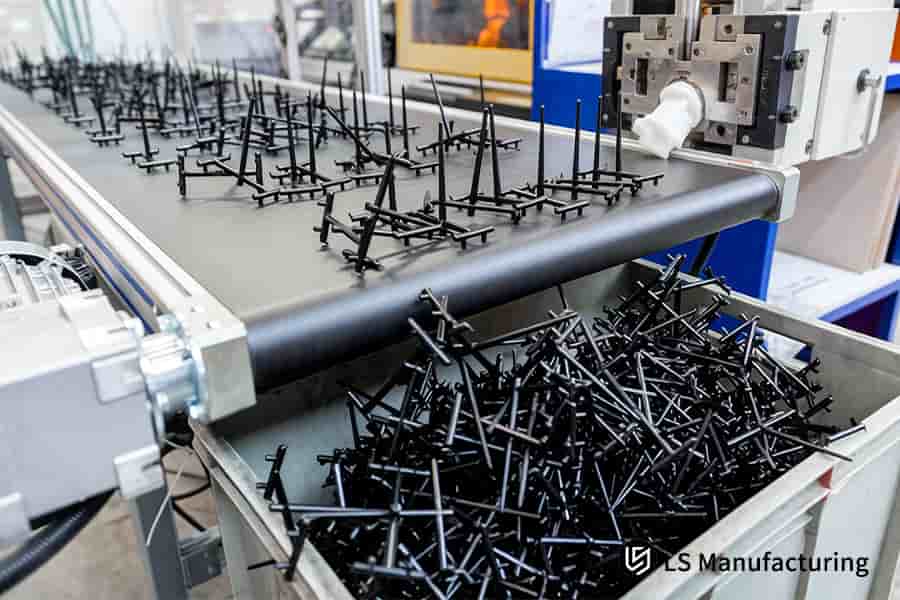
Figure 4: Conveyor transports black plastic hangers through final packaging stages using automated sorting mechanisms.
Case Study: LS Manufacturing Medical Device Housing Custom Injection Molding?
A top U.S. medical device company had to deal with a serious problem involving their PC/ABS ventilator housing where the initial T1 parts showed signs of a warp of 1.2mm at mating areas along with sink marks of 0.15mm deep around the snap fit features, and the problem put $15,000 and six weeks of delay at stake.
LS Manufacturing came to help within two days and applied DFM in reverse and multi-runner Moldflow simulation for the rescue of this project. Below are our actions towards turning this catastrophe into first-pass qualification and providing a custom injection molding quote.
Client Challenge
Initially, with the single-edge gates, the uneven packing led to warping up to 1.2mm (way above the ±0.2mm allowed) and the presence of sink marks 0.15mm deep around the intersection of the ribs. In response to that, the old manufacturer quoted the price of $15,000 for modifying the molds and a delay of 6 weeks, and that made the client look for an injection molding DFM supplier.
LS Manufacturing Solution
In less than 72 hours, we upgraded the one-edge gate to a hot runner system supplying three open valve gates. Cavity pressure was equalized for all wall transitions. Rib wall thickness was lowered to 55% to avoid local accumulation of material. We used conformal cooling within the core slider along with multistage packing of 110 MPa, which resulted in uniform shrinkage and the absence of sink marks in a medical-grade plastic injection molding solution.
Results and Value
The first trial, T1, yielded parts with ≤0.15mm warpage (the requirement was up to ±0.2mm) and no sink marks at all. Mold modifications were not required; the project went through PPAP without any issues on the first try. The client gained 100% of their potential $15,000 worth of costs to be spent on rework and 28 days of saved schedule. In the aftermath, all five upcoming premium mold programs were referred to LS Manufacturing for high-quality plastic injection molding of critical devices.
Using quick DFM correction, hot runner adjustment, conformal cooling, and precise packaging, we converted a failed ventilator housing design into a successful one in the first try. You benefit from free rework expense, faster market launch, and an established company specializing in intricate medical housings. In this instance, you understand why expertise in plastic injection molding service make the difference between theory and practice.
Turn your failed T1 into a first-pass success. To avoid $15,000 in rework and six-week delays, contact our DFM team for a rapid mold analysis and a production-ready quotation.

FAQs
1. Why should I review a DFM report before finalizing a custom injection molding quote?
As much as 95% of design errors can be discovered through a DFM analysis. Issues related to wall thicknesses, gating processes, and potential warping will be highlighted, preventing expensive mold adjustments when producing large volumes—thus, being the most effective prevention tool that ensures your project remains within budget.
2. How does LS Manufacturing minimize hidden tooling costs for overseas buyers?
Through in-house Moldflow Simulation, scientific studies on plastic injection molding process parameters, and thorough T1 mold trials, LS Manufacturing avoids more than 90% of secondary mold modifications and downtime, thereby avoiding any hidden costs associated with tooling.
3. Can your injection molding DFM supplier optimize complex parts for metal-to-plastic conversion?
Absolutely. Being a leading plastic injection molding DFM provider, LS Manufacturing makes use of Finite Element Analysis (FEA) to substitute regions of excessive material thickness with ribs, keeping the same mechanical integrity, but cutting down the overall part weight by 40%.
4. What surface finish standards can a precision plastic molding manufacturer guarantee?
Our company is capable of providing all types of surface finishes, including high-gloss mirror surfaces (SPI A-1 grade with Ra ≤0.02μm) to even automotive surface textures (VDI 3400 grades 12–36). As a precision plastic molding manufacturer, we also provide smooth and clean surfaces during part removal.
5. How do you handle intellectual property (IP) protection during the plastic injection molding service?
Intellectual property means everything to us. Our company uses a fully isolated LAN for our technical drawings, signs internationally legally binding NDAs with all of our customers, and imposes stringent control over access inside the workshop to make sure that you can enjoy 100% secure isolation of your trade secrets.
6. What is the typical lead time for cost-effective mold tooling solutions at LS Manufacturing?
In case of precision single-color molds, T1 (first article) will be ready in about 18 to 25 days. Applying DFM optimization at the initial stages allows us to save a great deal of time when adjusting and troubleshooting the molds after production has been completed, thus ensuring that we deliver 100% predictable cost-effective mold tooling solutions.
7. Does LS Manufacturing have a minimum order quantity (MOQ) requirement for custom injection molding?
Although we deliver highly competitive prices on medium to high-volume manufacturing orders, we also keep a flexible batch trial manufacturing process (minimum 500 pcs), which enables innovative businesses to transition smoothly into commercial manufacturing through seamless integration between design and manufacturing phases.
8. Why can your engineering intervention slash injection molding tooling costs more effectively than competitors?
Whereas most competitors simply trim down molds according to the drawing, we have a unique engineering intervention program managed by professional architects with over 15 years of experience. Potential errors are eliminated at the digital stage without ever touching steel molds. Our unique technical skill ensures we can reduce costs of injection tooling for our clients significantly. Unlike standard mold shops, we eliminate errors digitally before steel is cut. To validate this engineering advantage for your project, contact our senior design team for a DFM review and a cost-optimized quotation.
Summary
Getting precise plastic components is a competition of early engineering intervention, manufacturing constraints, and cost mitigation. Tooling costs repeatedly arise due to neglecting injection physics principles in the design phase such as wall thickness transition, material flow, and cooling differences. By partnering with suppliers that utilize advanced DFM defect control, global OEMs can significantly reduce their time to market by 30%.
Avoid having any design issues become costly mold revisions post-production by ensuring they do not occur in the first place. Prior to your next design process, click the “Get Quote” link to upload your STEP/IGS file. In less than 24 hours, you will receive a preliminary technical analysis on your parting line, gating location, and more.
📞Tel: +86 185 6675 9667
📧Email: info@lsrpf.com
🌐Website: https://lsrpf.com/
Disclaimer
The contents of this page are for informational purposes only. LS Manufacturing services There are no representations or warranties, express or implied, as to the accuracy, completeness or validity of the information. It should not be inferred that a third-party supplier or manufacturer will provide performance parameters, geometric tolerances, specific design characteristics, material quality and type or workmanship through the LS Manufacturing network. It's the buyer's responsibility. Require parts quotation Identify specific requirements for these sections.Please contact us for more information.
LS Manufacturing Team
LS Manufacturing is an industry-leading company. Focus on custom manufacturing solutions. We have over 20 years of experience with over 5,000 customers, and we focus on high precision CNC machining, Sheet metal manufacturing, 3D printing, Injection molding. Metal stamping,and other one-stop manufacturing services.
Our factory is equipped with over 100 state-of-the-art 5-axis machining centers, ISO 9001:2015 certified. We provide fast, efficient and high-quality manufacturing solutions to customers in more than 150 countries around the world. Whether it is small volume production or large-scale customization, we can meet your needs with the fastest delivery within 24 hours. choose LS Manufacturing. This means selection efficiency, quality and professionalism.
To learn more, visit our website:www.lsrpf.com.