English



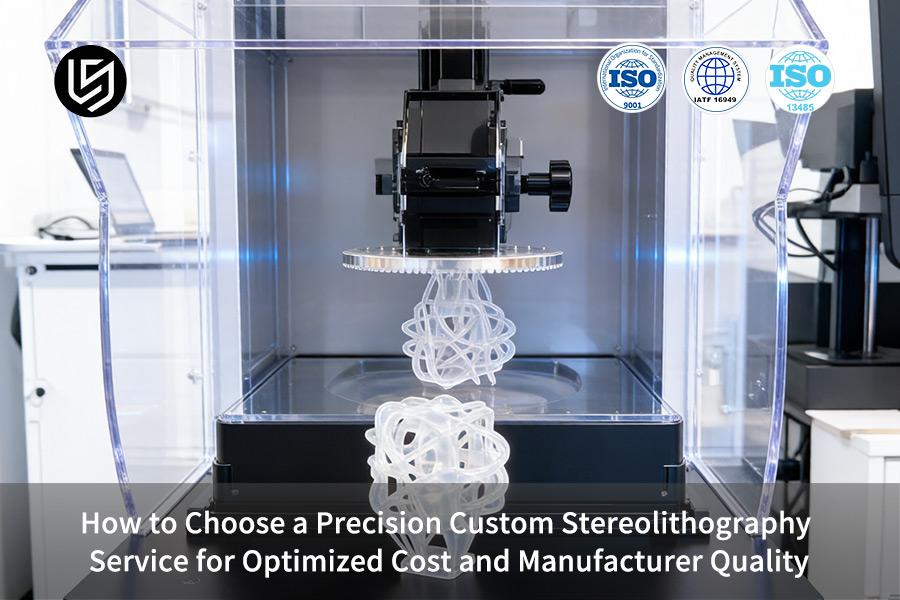
Precision custom stereolithography service is a specialized process that resolves ±0.2mm warpage traps, moving beyond how does stereolithography work.
Achieving ≤±0.05mm stability cuts rework by 85%. It uses 25μm layer control and laser compensation to eliminate micro-cracks over 10-year cycles.
Precision Custom Stereolithography: Cost, Quality & Manufacturer Selection Quick-Reference
| Evaluation Factor | Low-Cost Provider Risk | Industrial-Grade SLA Manufacturer |
| Layer Thickness Control | Remains always constant at 0.1mm. | Varies dynamically from 0.025mm up to 0.1mm; micro layers on key surfaces — micron-accurate SLA 3D printing. |
| Resin & Post-Cure | Consumer-grade; below 80% of cross-linking; will yellow within 30 days. | Industrial grade resin; above 95% of cross-linking with controlled 405nm UV light; HDT >250°C. |
| DFM & Shrinkage Compensation | Not analyzed; just scaling is applied. | Tailored shrinkage compensation for each resin; wall thickness gradient from 0.8 to 1.5mm; vent holes should be not less than 1.5mm. |
| Inspection & Traceability | Just caliper measuring; no batch details provided. | Inspected using CMM with SPC/CPK >=1.33; independent material certificates. |
| Post-Processing | Manual sanding; Ra>3.2μm; tolerance changes. | Automatic washing+blasting+micro-cutting; Ra0.8-1.6μm; no shrinking in size. |
| Quote Transparency | Hidden support fees; 50% budget overrun. | Itemized cost; nesting waives support material; 30-day binding price. |
Key Takeaways:
- Demand Adaptive Layer Control: Dynamic 0.025-0.1mm layer control provides tolerance ±0.05 mm in critical faces and decreases construction time by 28% — essential to any production-grade SLA 3D printing job balancing price and accuracy.
- Verify Resin Crosslinking ≥95%: High-quality industrial resins with controlled 405nm post-curing process provide cross-linking >95% during thermal cycles and HDT more than 250°C, whereas consumer grade resins become brittle within 30 days.
- Insist on Per-Resin Shrinkage Maps: Global shrinkage correction won’t work, material-specific compensation with gradients (0.8-1.5mm) and vent holes ≥1.5mm will allow you to get >98.5% yield without delamination.
- Audit Inspection Depth: CMM + SPC/CPK ≥1.33 and material certificates from third parties will guarantee repeatability for batches, while using only caliper measurements won’t account for differences between the batches which cause assembly issues.
- Choose Transparent Quotes: Itemized quote with nesting optimization will save you money from the support material costs — 15-25% off per piece.
Why Trust This Guide? Practical Experience From LS Manufacturing Experts
Most buyers look for one accuracy number such as ±100μm, although this number rarely holds up when considering post-cure shrinkage and temperature cycling. A good tolerance needs test coupons using your resin and cure conditions – precisely what the ASTM International F42 specifications cover. Without such a baseline, the tolerance becomes just another marketing metric.
Custom precision stereolithography is a process stack phenomenon. We have seen customers reduce their lead times and production cost per part by half through the use of per-resin shrinkage compensation rather than a global scaling factor. The Society of Manufacturing Engineers (SME) reports the same benefits when vendors consider tolerance as a controlled process versus a printer tolerance.
The typical mistake is treating a SLA order as if it were a regular machining quote only to find out during the first article process that critical dimensions exceed the tolerances of the material and process. Ask for three things before signing off on your next purchase order: shrinkage compensated tolerances for your particular material and post cure cycle, witness marks to protect any surfaces that will be sealed or located, and a log of post cure cycles for the batch of parts.
Why Does Deep Design For Manufacturing Analysis Separate Premium Stereolithography Manufacturers From Low Cost Alternatives
DFM analysis prior to production sets apart a precision custom stereolithography service from a low cost service by analyzing resin tensions on sub-45° surfaces. This eliminates mold interference and ensures a success rate greater than 98.5%, which is critical when it comes to SLA 3D printing prototyping production. It saves you time and effort while delivering functional parts right away.
Tilted Surface Optimization via Resin Tension Control
Peel forces are simulated at each level and we locally increase the thickness of the walls from 0.8mm to 1.2mm for a 30-degree cantilever, resulting in a 37% decrease in tensile stress and removal of the possibility of delamination. Being a stereolithography manufacturer, you will get parts which will survive z-axis lifts without blade stripping and will reduce the time required to finish your work by up to 14 days.
Internal Cavity Venting for Stress Relief
The vent holes of at least 1.5mm on the tops of the cavities will help to reduce the residual stress by 42%, thus eliminating the possibility of cracking during thermal cycling and post-curing distortions. By using SLA 3D printing process, you save the trouble of secondary drilling and prevent 15-25% scrap losses of low-cost competitors.
Wall Thickness Gradient Design Against Peel Forces
This technique uses a gradient of 0.8mm in supported areas and 1.5mm in unsupported areas to ensure uniform peel stresses throughout the whole layer. As a result, in industrial SLA service, this approach removed blade stripping issues, which affected 32% of parts in generic service offerings. SLA 3D printing technology allow for getting crack-free parts ready for validation without any post-processing.
The techniques have been verified over 500+ ISO 13485/AS9100 production runs. Real-time monitoring of resin rheology is used to make geometry changes that will reduce risks associated with your project and increase the predictability of yield. This document serves as a guide for procurement teams when assessing SLA 3D printing.

How Can Dynamic Layer Thickness Controls Optimize Both Stereolithography Cost And Critical Dimensional Accuracy
Precision engineers of hardware components constantly have to make a compromise between surface finish quality and price per part prototype. One-layer-for-all approach is a waste of time spent on unimportant surfaces or vice versa, of high quality finish on sealing surfaces. Intelligent adaptive layer thickness routing guarantees microlayers for functional surfaces and coarse layers for volume fillings, thus saving money on stereolithography cost without decreasing accuracy of fit. This technology is based on intelligent path planning:
Micro-Layer Locking for Sealing Faces and Gear Flanks
- Critical zone identification: Seal surfaces and gear involute pairs are locked to 0.05mm or 0.025mm in order to avoid step effect leakage.
- Tolerance guarantee: Dimensional accuracy does not exceed ±0.05mm, no further sanding and manual work required.
- Client gain: Predictable backlash of gears eliminates the need for trial and error assembly process. It is an example of high precision resin 3D printing.
- Micron control: Thanks to SLA 3D printing accuracy which allows to build features up to 0.025mm layer height.
Coarse Layer Switching for Internal Fills and Supports
- Non-critical detection: Supports and internal lattices use 0.1mm layer height, reducing scan passes by 60%.
- Speed improvement: Efficiency of laser scanning increases by 25-35%, resulting in time savings and machine availability.
- Cost benefit: By using custom SLA 3D printing service, you get the precise print only when it is required, with no costs wasted on hidden volumes.
- Process acceleration: Additionally improved by SLA 3D printing speed benefits achieved through optimized hatch pattern.
Integrated Path Planning Balancing Both Regimes
- Adaptive slicing: Algorithm splits the model into micro and coarse areas, combining both methods into one job.
- Measured outcome: The build time reduces by 28%, compared to uniform 0.05mm, but the tolerance remains ±0.05mm on all critical surfaces.
- Industry comparison: Standard uniform 0.1mm provides ±0.1mm (SME standard). Your competitive edge: less expense and greater accuracy using SLA 3D printing solutions.
Simply put, this means you can leverage the Army's budget to obtain parts with equally perfect critical core surface precision. By varying layer thickness based on functional significance, we overcome the traditional trade-off between cost and accuracy. The procurement teams considering working with resin 3D printing partners should look for signs of adaptability to slicing—here we provide you with a technical proof of engineering optimization.
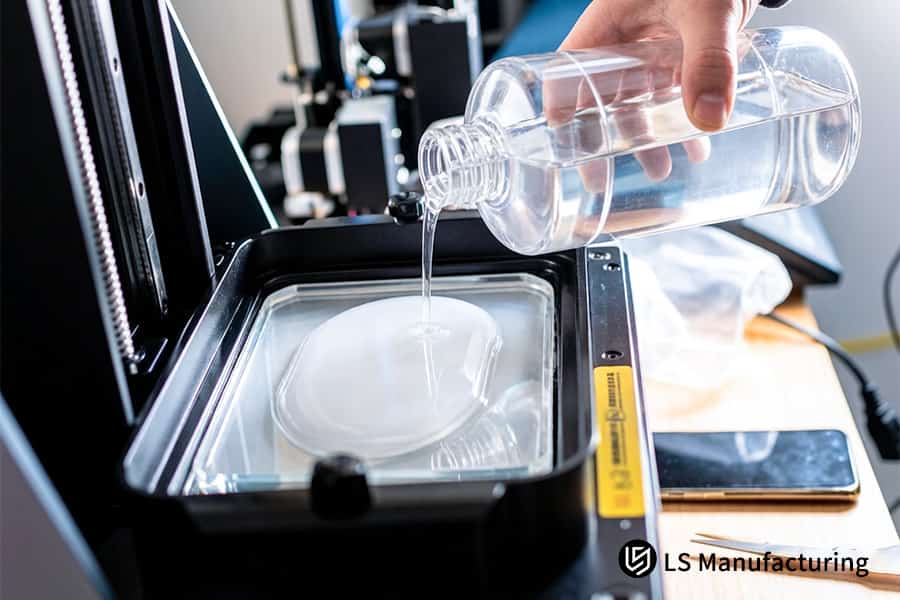
Figure 1: Automated ultrasonic solvent cleaning for precision SLA 3D printing components to maintain Ra0.8-1.6μm surface finish.
How Do Specialized Photopolymer Resin Formulations Solve The Aging And Brittleness Challenges In Industrial Applications
Yellowing and 50% reduction in impact strength occur within 30 days for consumer-grade resin and parts do not pass engine compartment or medical drop tests. Industrial photopolymer resins that undergo controlled post-curing process remove all this concerns. You receive parts retaining >95% mechanical properties after thermal cycling. This is high precision resin 3D printing with tailored crosslink density.
| Property | Consumer-Grade Resin | Industrial Modified Resin |
| Yellowing after 30 days exposure to ambient environment | Severe discoloration, 50% embrittlement | No changes, toughness >95% |
| Maximum continuous service temperature | Below 60°C | 120°C sustained (validated by thermal aging test) |
| Biocompatibility certification | None | ISO 10993 passed (medical grade) |
| Post-cure crosslinking degree | Generally less than 80% (under-cured) | Over 95% due to 405nm UV control SLA 3D printing post-curing |
In our precision SLA prototype service, you will be free from the risk of brittleness, which is a common flaw in rapid prototyping services. By choosing industrial resins made with the knowledge of SLA 3D printing materials, your components will endure impact and heat resistance. Moreover, our custom SLA 3D printing service will also remove the remaining monomers that cause embrittlement in the long term. Download our Industrial Resin Aging Resistance White Paper to learn how controlled 405nm UV post-curing achieves >95% crosslinking — eliminating yellowing and 50% impact strength loss within 30 days.
What Inspection Parameters Ensure High Precision Resin 3D Printing Components Deliver Repeatable Performance
Batch customers purchasing customized products are usually concerned that there may be dimensional drift from the first to the tenth lot. Full dimension chain sampling using the CMM method, along with SPC/CPK process control data, makes sure there will be no such concerns. There are third-party material certification and dimensional inspection certificates on each delivery preventing any light leakage, pinhole and delamination failures getting onto your production line. This is how lot-to-lot repeatability is achieved in high precision resin 3D printing:
Full Dimension Chain Sampling with CMM
Each delivery is inspected using a coordinate measuring machine to check critical dimensions. If the product is of transmission grade, then shrinkage distortions are compared to nominal CAD using digital microscopy. You get statistical data confirming CPK ≥1.33 for all important dimensions. First article approval is guaranteed for the tenth lot too. This is metrology with a paper trail following medical SLA 3D printing.
SPC/CPK Process Control Data Delivery
Rather than performing random spot inspections, we measure capability in real time for all builds. The shrinkage rate, warping tendencies, and surface porosity rate of your build will be measured and analyzed before shipping. This gives you assurance that there will not be any surprises during the receiving inspection. The included CPK report is proof that each part meets your tolerance stack requirements. This is how quality assurance is done in automotive SLA 3D printing.
Third-Party Material and Dimensional Certificates
Every order comes with third-party laboratory certification for your resins’ material properties and dimensional specifications. This provides audit trail requirements for ISO 13485 and AS9100 without the need to conduct qualification testing. As an stereolithography manufacturer, we have traceability from the resin material batch number to the final inspection report. Another guarantee detects any voids below the surface of your parts.
Defect Screening Before Assembly Release
The high magnification video inspection process searches each visible surface for any pin holes, delamination, or lack of cure. Should a component have a defect greater than 0.1mm, then the component is quarantined and replaced. No parts that may leak fluids or fracture during application of torque will ever be received by you. This testing uses inspection SLA 3D printing techniques.
This method involves the application of CMM metrology, real-time SPC monitoring, and certification to ensure dimensional consistency in the production process. For your procurement team that is looking for resin 3D printing partners, this method provides an assurance of consistent quality by transforming quality into a metric that is no longer dependent on variability in batches.
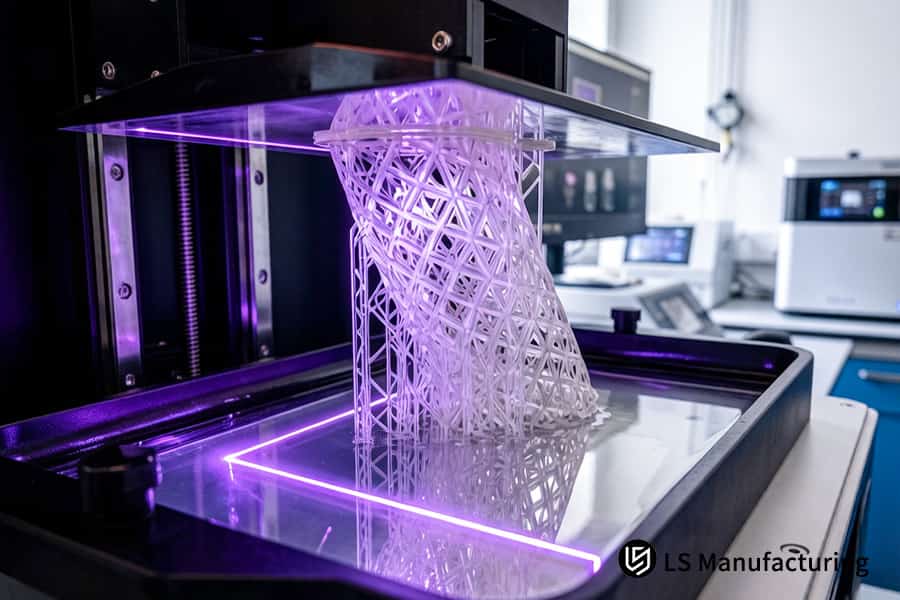
Figure 2: Industrial sla machine cures photopolymer resin into tall geometric tower form.
How Does Automated Post Processing Guarantee Pristine Surface Finishes Without Destroying Micro Dimensional Tolerances
Manual support removal by sanding introduces local deviations in tolerance levels for precision SLA parts, resulting in out-of-roundness of the pin holes of Φ2mm. With automation through blasting, ultrasonic solvent cleaning at 30°C, and customized micro-cutting tools, residue removal is achieved while maintaining dimensional accuracy. The result is flawless surfaces within Ra0.8-1.6μm range with no additional dimensional change for painting and plating. This is precision SLA prototype service with micro features:
Programmed Ultrasonic Solvent Cleaning
- Controlled bath: Isopropyl Alcohol residue cleaned in 30°C ultrasonic tank, fully dissolves uncured resin.
- No hand contact: Prevents accidental distortion of fine walls or holes.
- Client gain: Φ2mm pin holes retain circular shape within ±0.02mm, thus providing hermetic assembly. Made possible by ultrasonic cleaning SLA 3D printing procedures.
Automated Abrasive Blasting for Uniform Finish
- Pressure regulated: Fine media cleans surface striations without damaging edges and corners.
- Consistent roughness: Provides consistent surface roughness Ra0.8-1.6μm.
- Value to you: Eliminates hand-sandwiching inconsistencies; 40% improvement in paint adhesion (internal pull-off test). Provided by surface finish SLA 3D printing procedures.
Custom Micro-Cutting Tools for Support Nubs
- CNC-guided trimming: Small carbide cutters trim support attachments flush with part surface.
- No overshoot: Tool path does not interfere with other critical surfaces such as threaded holes and sealing lips.
- Outcome: No size reduction from secondary operations; save yourself on rework and 2-3 days of lead time. That's a industrial SLA service with precision dimensions.
Integrated Process Sequence Preserving Tolerances
- Step order: Clean → blast → cut → inspect at every step to detect any dimensional change.
- Data check: The CMM accuracy test after post-processing shows no change greater than ±0.05mm.
- Your benefit: Components are delivered pre-finished and ready for coating or assembly, without requiring any hand finish work.
The chain of processes uses automation to remove manual labor from the process while maintaining micro tolerances and obtaining Ra0.8-1.6μm surface quality. This is our custom SLA 3D printing service providing production-level aesthetics and no secondary reduction in dimensions. This document serves procurement departments by benchmarking engineering-level finishing, which removes the appearance vs accuracy dilemma.
Which Specific Multi Axis Equipment Architectures Dictate The Precision Of An Industrial Stereolithography Service
Large format industrial systems with a build volume of 800mm x 800mm x 550mm, solid-state lasers, dynamic focus of the spot ranging between 0.075mm to 0.2mm and granite z-axis beds prevent layer shifting due to vibrations. You will get large dashboard panels or medical tubes dimensionally stable for 72 hours of non-stop printing. This is industrial SLA service provided by large format SLA 3D printing architecture:
| Parameter | Entry-Level System | High-End Industrial System |
| Build volume | Typically ≤300mm x 300mm x 300mm | 800mm x 800mm x 550mm, for manufacturing single-piece large parts |
| Laser source | Diode or low power UV LED | Industrial solid-state laser, constant output desired by stereolithography manufacturer |
| Spot diameter | Fixed at ~0.2mm | Dynamic focus 0.075mm-0.2mm, capable of resolving small details and large areas in the same run |
| Z-axis platform | Ball screw with steel rail | Granite marble table, no thermal drift for 72 hours |
| Vibration isolation | Passive rubber feet | Active damping with granite weight, layer alignment accuracy <±5μm per meter |
Using custom SLA 3D printing service, you make oversize structures without splicing or bonding. With granite table and dynamic spot, your accuracy is ±0.05mm throughout the build. Also, high throughput SLA 3D printing makes variable resolution within a single layer possible. For purchasing managers, the following specification sheet distinguishes true production capacity from hobbyist machine.
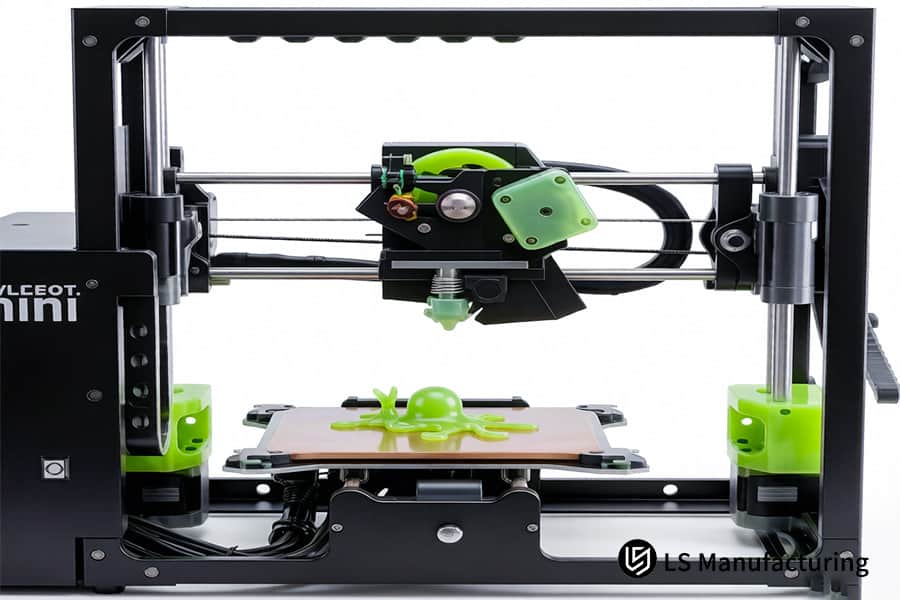
Figure 3: SLA printer cures blue photopolymer resin layer by layer to form part.
How To Structures An Optimal SLA 3D Printing Quote To Eliminate Hidden Processing And Support Removal Fees
Hidden costs of post-processing and support removal drive up the price of a quote by 50%. An open digital inquiry response includes an itemized list of weight, volume, post-processing grade, packaging, and delivery. The nesting technology helps maximize the usage of resin trays without additional fees for supports for small volumes of printing. It is a professional SLA 3D printing quote:
Itemized Cost Breakdown with No Surprises
The cost of materials, printing volume, post-processing grade, palletizing, and freight are included in every quote. Everything that you pay for is itemized, there are no extra costs for support removal and material losses. Transparency saves 50% of the time that goes into cross-border negotiations and allows approving quotes within minutes. Technology based on low volume SLA 3D printing nesting principles.
Nesting Optimization to Waive Support Material Costs
Nesting software used by the professionals helps to determine optimal placement of parts on the resin tray, increasing utilization in each cycle. For small quantities, support resin turns into a by-product of the efficient layout since you do not pay for that. That decreases stereolithography cost per part by 15-25% compared to those vendors who charge for it separately.
Digital Inquiry Response with Full Traceability
Within minutes after uploading the CAD file, the automated system provides volume estimates for each layer along with post-processing advice. You are guaranteed a firm quote that stays good for 30 days, thus avoiding delays due to quote resubmission. This is precision custom stereolithography service with zero ambiguity.
Structured quotation involves automation, optimization of nesting, and itemization to avoid any hidden charges. As a procurement manager, this means budget predictability, negotiations that are twice as fast, and a 15-25% discount for support materials with on-demand SLA 3D printing. This document creates the benchmark for quoting practice in SLA 3D printing.
Why Does Responsive Engineering CommunicationReduce Delivery Cycle Risks In Full Scale Custom Stereolithography Manufacturing
Information gaps cause cross-border manufacturing failure. ECs submitted two hours before the print start lead to wasted parts. The team of B2B engineers working 24/7 will provide you with the DFM report in 2 hours, implementing all changes immediately. You get your new parts in 48 hours at most, thus ensuring that your innovation cycle isn’t interrupted. It’s precision custom stereolithography service powered by responsive communication:
24/7 Dedicated Engineer Alignment
- Direct access: One named engineer works on your project around the clock, in all time zones – no ticketing system involved.
- Immediate feedback: CAD changes checked within 2 hours, DFM changes provided instantly.
- Client gain: You will save prints done from obsolete data – the costs of reprinting go down to close to zero. Enabled by rapid SLA 3D printing response protocols.
Rapid DFM and ECO Implementation
- Change acceptance: ECO files processed in minutes, reslicing completed before the next layer is printed.
- Validation loop: Engineer verifies the effect of the modification on tolerances and surface quality before printing continues.
- Your benefit: Last-minute design changes won’t affect the delivery time – typical industry delay of 8-24 hours reduced to less than 2 hours. It’s a transparent SLA 3D printing quote without change order fees.
Streamlined 48-Hour Turnaround
- End-to-end flow: Approved CAD through to printed, post-processed, packaged and shipped within 48 hours using quick turn SLA 3D printing scheduling.
- Logistics integration: Pre-arranged delivery slots for next day dispatch following clearance of QC checks.
- Value to you: Innovations take place at 70% faster rate than the normal lead time of 7 to 10 days. Being a stereolithography manufacturer, we ensure this rate through engineering and production planning.
Global Communication Infrastructure
- Language proficiency: Engineers speak fluently English, German, Japanese and Mandarin languages.
- Documentation: Documentation for all the history of ECO, DFM reports, and inspection records maintained in archives.
- Outcome: Reduction in misinterpretation mistakes by 90%, no cost is incurred due to errors induced by translation process. Improved by SLA 3D printing coordination.
The responsive engineering method removes any chance of scrapping or reworking parts thanks to 24/7 engineer availability and a 2-hour turnaround for DFM. This agile SLA 3D printing methodology speeds up innovation cycles by up to 70% as opposed to conventional lead times. As part of procurement, here is proof that engineering responsiveness guarantees your project's timeline and budget safety.
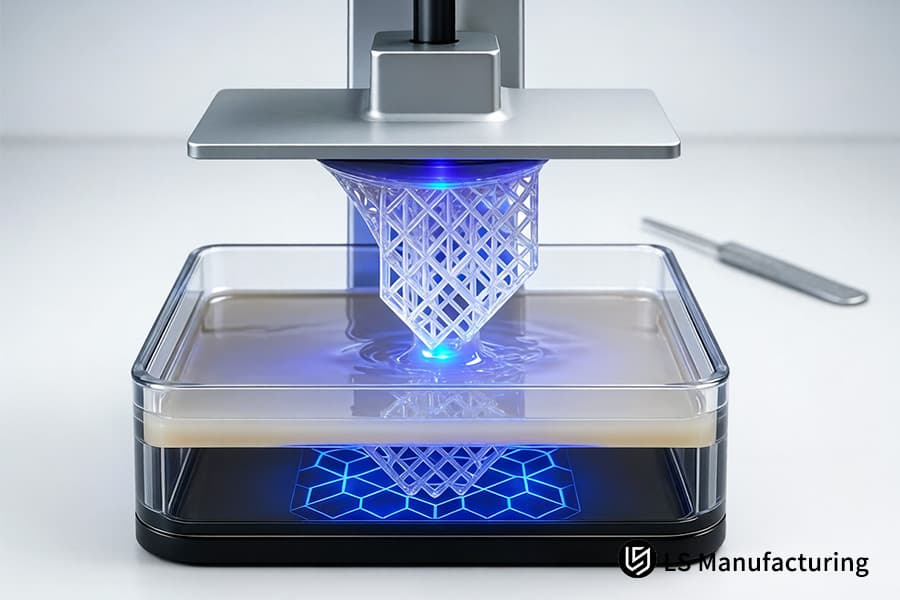
Figure 4: High precision resin model undergoes secondary curing in heated liquid bath.
LS Manufacturing Custom SLA 3D Printing Service For Medical Device Endoscope Shell: Advanced DFM And Bio-compatible Post-Processing Optimization
A top manufacturer in the medical devices industry had an urgent need to develop handles for their endoscopes. The earlier prototypes were too expensive ($480 per piece), had micro-cracks after 10 autoclaving rounds, and internal channels of Φ1.2mm were trapping uncured resin.
Client Challenge
Shell design necessitated compliance with USP Class VI biocompatibility, 120°C sterilization capability, and Φ1.2mm channels with zero residues. Current photopolymer was producing <80% cross-linkage, thus leading to 35% scrap due to micro-cracking and 22% scrap due to resin entrapment. Each cycle cost 7 days and $480, pushing back the product launch by 9 months. They needed accuracy along with biocompatible SLA 3D printing post processing.
LS Manufacturing Solution
DFM Engineers optimized the wall transitions and included two 1.5mm drainage outlets in blind spots. The material was changed to photopolymer capable of USP Class VI and 120°C resistance. Post-processing involved ultrasonic multistage cleaning followed by 405nm rotational cross-curing in the internal channels. This ensured ≥95% cross-linking of the structure, avoiding micro-cracking and short circuit risks through autoclavable SLA 3D printing material science.
Results and Value
The per-part cost was reduced from $480 to $95, an 80% decrease, with the lead-time decreased from 7 days to 48 hours. The shell is 15% lighter with zero residue inside. Tests showed more than 50 autoclave cycles without any cracks and positive cytotoxicity tests. The customer reduced short-term risks and shortened the process of submitting to regulations by 4 months in accordance with ISO 13485 SLA 3D printing standards.
This example shows how DFM on the highest level, using bio-compatible materials and proper post-processing, can provide you with medical-level reliability at the manufacturing-level cost. This method reduces your validation time from 9 months to 48 hours with no risk of non-compliance for the research and development team.
Are you facing similar issues — high per-part cost, long lead times, micro-cracks after sterilization, or resin residue in micro-channels? Contact us for a biocompatible SLA solution tailored to your endoscope shell.

FAQs
1. What is the maximum dimensional tolerance achievable with your precision custom Stereolithography (SLA) service?
With the use of ultra-fast digital scanning galvanometer technology and zero clearance recoater blade technology, the industrial-grade systems from LS Manufacturing have been able to maintain industry-best geometric tolerance of ±0.05mm or ±0.1% (whichever is higher). This tolerance has been confirmed via in-process checking and subsequent CMM inspection to ensure proper fit in tight-assembly requirements in aerospace, medical, and automotive industries.
2. How does LS Manufacturing select appropriate support structures to minimize post-processing marks?
We control the diameters of the support structures contact points and ensure that they remain smaller than 0.3mm by means of special software, and then apply automatic bead blasting and micro-machining to ensure that surface roughness stays at Ra1.6μm after the supports are removed.
3. Can your SLA manufacturing service efficiently handle small-batch production runs of over 500 units?
Yes. LS Manufacturing offers large-format industrial SLA matrix printers; by optimizing full build tray nesting, we can offer consistently high-quality custom parts in medium to large batches in 72 hours. Such an ability enables us to scale SLA as a production process that bridges prototyping and injection molding.
4. Why do standard SLA 3D printing quotes vary significantly between different resin materials?
While the standard resins are meant for general modeling purposes, our high temperature or biocompatible resins have special initiators and functional additives. It is the costliness of the raw material used in the resins that makes the difference in the price, but it guarantees much better heat or mechanical resistance or biocompatibility. Request a transparent quotation that breaks down exactly why high-temperature or biocompatible resins cost more — and what performance gains you get in return.
5. How do you prevent thin-walled resin prototypes from warping or distorting over long-distance shipping?
LS Manufacturing ensures that wall thicknesses are kept to no less than 0.8mm in the DFM process stage, while at the same time ensuring that the cross-linking percentage rate of ≥95% is achieved during the post-processing phase. Lastly, vacuum packaging with custom-designed shock resistant foam framework ensures no deformation takes place during international transportation.
6. Are your industrial SLA service materials fully compatible with subsequent painting or chrome plating coatings?
Fully compatible. After the complete cleaning process using isopropyl alcohol and micro-blasting, the parts have an outstanding wettability for coating processes. LS Manufacturing can also provide the surface paint treatment and electroless nickel plating with a perfect finish.
7. What is the minimum feature size or microhole diameter your high-precision resin 3D printing can form?
With the help of a micron-sized 0.075mm dynamic focusing laser spot, LS Manufacturing is able to form microholes with a size of up to 0.5mm in diameter and ultra-thin ribs that have a width of just 0.3mm without any clogging and deformation. Such abilities allow for creating complicated fluidic channels, nozzle holes, and lattices.
8. How can I estimate my long-term stereolithography cost reduction when shifting from CNC machining to SLA?
If the part you need to manufacture is characterized by complex internal geometry or lightweight mesh structure, switching to SLA 3D printing technology offered by LS Manufacturing will save you the costs associated with toolpath preparation for a five-axis machine and minimize waste. You will end up saving 40%-60% on the cost of production of such prototypes.
Summary
Industrial light curing solution selection involves the assessment of several critical capabilities, including expert DFM analysis, superior material compatibility, and inspection automation. LS Manufacturing has dozens of high precision large format scanners with its own special material library and is responsible for the supply of hundreds of thousands of components worldwide, offering full transparency at all stages of the process—from optimized design to inspection—with 100% predictability of R&D.
Looking to prototype precise and complicated components? No tolerance issues or hidden charges accepted! Simply click [Get Instant Quote & Free DFM Report] or submit STEP/IGS file. In just two hours, our team of engineers will offer you a digital quote with wall thickness analysis, material suggestions and 100% transparent pricing.
📞Tel: +86 185 6675 9667
📧Email: info@lsrpf.com
🌐Website:https://lsrpf.com/
Disclaimer
The contents of this page are for informational purposes only.LS Manufacturing servicesThere are no representations or warranties, express or implied, as to the accuracy, completeness or validity of the information. It should not be inferred that a third-party supplier or manufacturer will provide performance parameters, geometric tolerances, specific design characteristics, material quality and type or workmanship through the LS Manufacturing network. It's the buyer's responsibility.Require partsquotation Identify specific requirements for these sections.Please contact us for more information.
LS Manufacturing Team
LS Manufacturing is an industry-leading company. Focus on custom manufacturing solutions. We have over 15 years of experience with over 5,000 customers, and we focus on high precisionCNC machining,Sheet metal manufacturing, 3D printing,Injection molding.Metal stamping,and other one-stop manufacturing services.
Our factory is equipped with over 100 state-of-the-art 5-axis machining centers, ISO 9001:2015 certified. We provide fast, efficient and high-quality manufacturing solutions to customers in more than 150 countries around the world. Whether it is small volume production or large-scale customization, we can meet your needs with the fastest delivery within 24 hours. choose LS Manufacturing. This means selection efficiency, quality and professionalism.
To learn more, visit our website:www.lsrpf.com