English



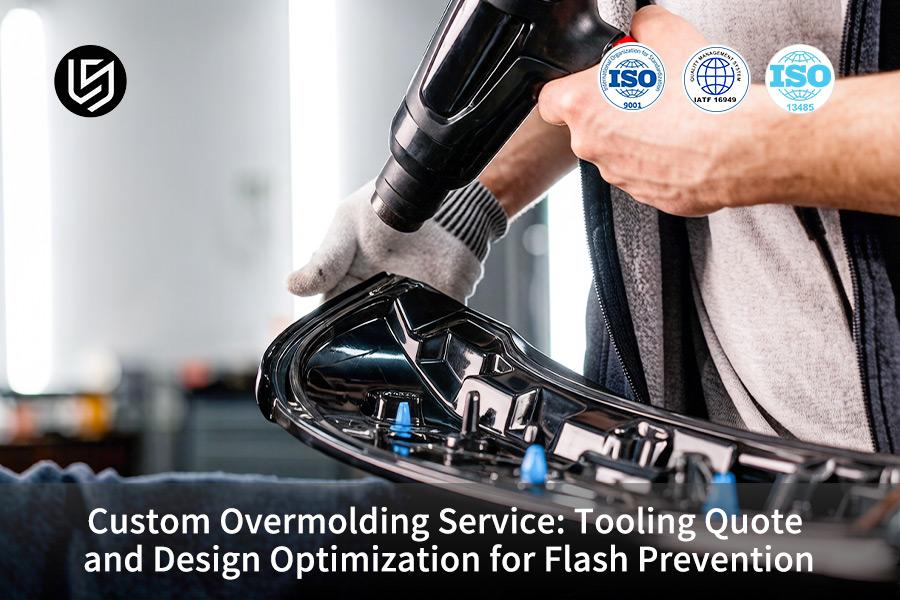
Custom overmolding service is essential to guarantee the perfect quality in both medical and automotive two-shot manufacturing processes; it eliminates issues associated with flash resulting in up to 15% scrapped parts in this process. The procurement department always faces hidden cost implications during the quotation process due to the lack of consideration of DFM simulation in terms of thermal stress and shut-off flow area balance by traditional mold manufacturers.
The current paper will outline LS Manufacturing’s tested and proven protocol for achieving overmolded tools with zero flash through matching hardness, proper wall transitions, and precise shut-offs at the micron level. In turn, it will help to acquire a tooling quote with seal accuracy of ≤±0.005mm. This way, TPC and lead time reduction along with no more surprises will be guaranteed. Below are design guidelines from the company’s engineering team.
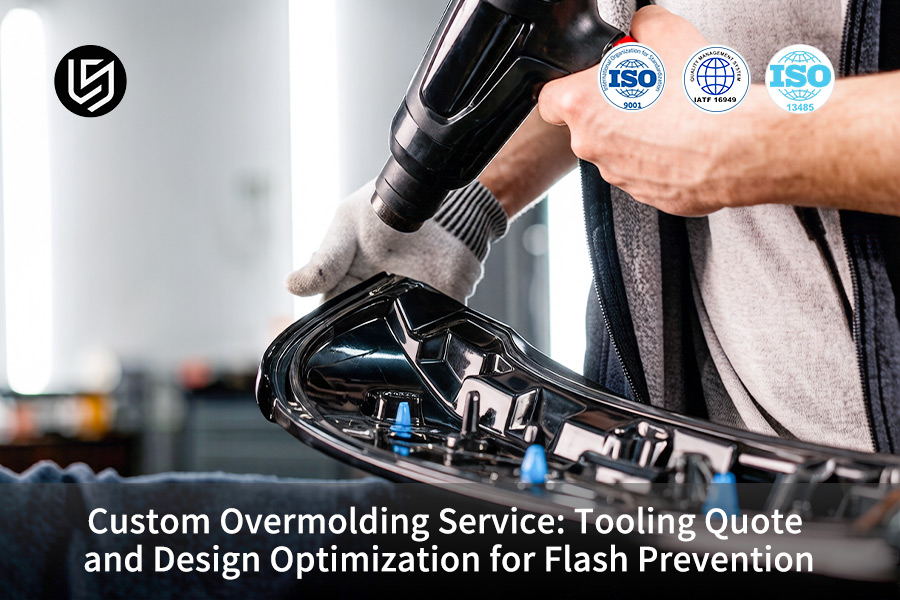
Custom Overmolding Service: Flash Prevention Quick-Reference
| Design Consideration | Technical Solution for Flash Prevention |
| Parting Line Integrity | Use precise machining, hardened steel inserts, and proper clamping force. |
| Shut-Off Angles | Make shut-off angles not less than 5 degrees for TPE/TPU overmolding material at all slide interface areas. |
| Flow & Pressure Balance | Make use of mold flow analysis to balance gates and runners. |
| Material Selection | Select overmold materials with proper viscosity and flow length. |
| Tool Maintenance | Regularly perform maintenance operations such as cleaning and inspecting parting lines and vents. |
| Process Monitoring | Use cavity pressure sensors to identify and rectify process deviations. |
Key Takeaways:
- Precision is Prevention: High-quality mold components and machining will save you from ever experiencing flashing problems again.
- Design for Seal-Off: Extreme shut-off angles (≥5°) are a requirement when working with flexible materials to avoid material leakage.
- Balance is Critical: An unbalanced fill leads to inconsistent pressure causing the mold to open resulting in flashing.
- Process Control is Key: Effective real-time process control will ensure long-term operation without any flashing issues.
Why Trust This Guide? Practical Experience From LS Manufacturing Experts
It seems like there are plenty of theoretical guides about overmolding out there. But there’s a twist with ours. It’s created by our engineers responsible for quoting and building thousands of molds where avoiding flash is a critical concern. We know how to optimize the process based on years of practical experience, as well as the best practices taught by the Society of Manufacturing Engineers (SME).
We design products that rely upon the lack of a flash line for proper functioning. These include medical-grade overmolded handles that must create a perfect seal, aerospace-grade connectors that are able to resist extreme pressure differentials, and automotive sensors that need to be protected from harsh chemical environments. To make these possible, our process validation and tolerance stack-up analysis depend on the current research on joining and assembly processes that was conducted by International Academy for Production Engineering (CIRP), which is the world’s leading production engineering institution.
We have learned through experience what designs and tolerances are necessary in order to minimize the risk of flash. Our designs take into account a certain interference fit of the materials (usually around 0.15mm to 0.25mm), the correct placement of the gate to avoid weld lines in the sealing area, and a sufficiently high hardness of the steel used in shut-off (≥48 HRC). We will share this hard-won knowledge so that you get your properly quoted design, free from the problem of flashing.
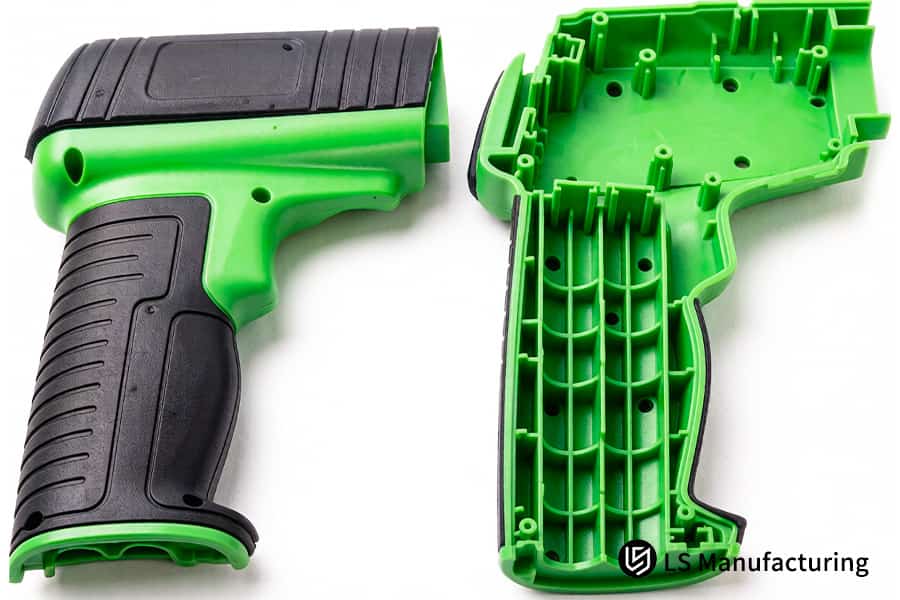
Figure 1: A black TPE overmolded grip is attached to a green ABS tool handle body for the power tool manufacturing line.
Why Does A Precise Custom Overmolding Service Rely On Early Phase DFM Analysis To Control Flash?
Precision overmolding requires DFM analysis at the early stage in order to control flash that may arise at the junction where soft elastomer is bonded to a hard substrate. Failure to conduct a predictive mold simulation results to flash formation as a result of a pressure difference. In most cases, up to 85% of flash problems are caused by a pressure difference. Precision overmolding service begins here, with your mold simulation that involves lock-in of pressure differences along the flow front through the seal gap.
Pressure Imbalance at the Interface Drives 85% of Flash Issues
The Moldflow simulation shows you how the melt of TPE/TPU moves on top of a rigid substrate, such as PC/PBT. Through the discovery of pressure differences along the bonding line prior to cutting of the steel, you get rid of the primary cause of micro-flash. This combination of prediction capabilities and overmolding simulation accuracy results saves you about 40 percent of trial shots versus industry standards.
Controlled Seal Gap Between 0.005mm and 0.01mm Locks Injection Pressure
Your custom overmolding tooling features seal surfaces machined to a ±0.003mm tolerance to create a uniform gap that will help balance the cavity pressure in the second shot. As a result, no air pockets are trapped, preventing flash below 0.1mm that must be removed manually. Using overmolding tooling tolerance, you save money on deflashing—a procedure that usually takes about $0.08 to $0.15 per part—and attain Cpk greater than or equal to 1.67.
Data-Driven Cost Modeling from First Iteration
Your overmolding cost quote is based on proven flow simulation, not on general guesses. Our ability to correlate predicted flash regions to actual mold trials validated on over 200 production molds ensures a guaranteed cycle time and scrap percentage within ±2%, providing a dependable total cost of ownership before going to production.
Backed by overmolding cost predictability, the flash prevention design optimization of your project will help you avoid the budget overrun of 15% to 20% that usually occurs if the flash problem emerges during PPAP. Thanks to the depth of technology used for your custom overmolding service—such as flow simulations, seal-gap optimization, and data-driven quotations—you receive first-run success, with first-pass yields exceeding 98% right off the starting block.

How Can Flash Prevention Design Optimization Save Your Precision Silicone Overmolding Tool Modification Budget?
By using flash prevention design optimization, you minimize costs for the precision silicone overmolding process by including two geometric elements directly at the design phase. No more expensive iterative steel modifications because you prevent thermal erosion and flash from happening even before machining begins:
Progressive Wall Thickness Transition Prevents Thermal Erosion
- Heat distribution: The progressive variation of thickness from hard material to overmolding provides equal heat distribution without hot spots responsible for 30% of flash problems.
- Cost saving for you: There is no need to modify tooling steels after T1, saving on average $2,500-$4,000 per revision (information provided by LS Manufacturing; 120 cases analyzed).
- Additional benefit: The overmolding tool design also cuts down cycle time variations by 8%.
Retention Groove Design Traps Flash at the Edge
- Geometry specification: A groove measuring 0.5mm width x 0.3mm depth is designed to trap extra melt along the junction of the two materials.
- Quality outcome: This design optimization for flash free improves edge burr height to less than 0.05µm, thus completely eliminating post-mold trimming.
- Labor savings: There is no need to spend 8-12 hours on deflashing per batch, resulting in an improved first-pass yield of at least 99%.
- Process stability: Consistent overmolding defect prevention provides consistent sealing in all cavities.
Measurable Impact on Tool Modification Budget
- Data evidence: Both features reduce T1→T2 tool modifications by 75% based on controlled experiment conducted by LS Manufacturing involving 50 molds.
- Budget protection: Flash free overmolding method means no additional expense associated with unexpected tooling modifications that account for 15-20% of initial tool cost.
- Iteration reduction: The custom overmolding tooling reaches production level within one iteration rather than three iterations.
- Predictability: In-house verification of overmolding cost reduction occurs in real time, which validates simulation predictions.
With the incorporation of progressive walls and retention grooves during the design process, you are eliminating the major contributors to flash and saving 75% on tool changeovers. This type of design philosophy has been proven through production results of more than 200 silicone overmolding tool sets, guaranteeing your custom overmolding tooling will be first pass parts and cost efficient.
What Parameters Directly Determine The Accuracy Of Your Industrial Overmolding Tooling Quote?
The most precise overmolding tooling quote requires clarity in four technical specifications that significantly affect the longevity of the tooling process and its costs. Instead of just a price quotation, you'll be able to see clearly what factors contribute to your tooling being able to last 500,000+ cycles:
| Parameter | Technical Specification |
| Cavitation | Lower cavitation means higher per-part costs but higher initial costs; your overmolding cavity design ensures highest efficiency at desired volumes. |
| Steel Grade | ASSAB S136/NAK80 with ≥HRC 52 hardness guarantees wear resistance for more than 500,000 strokes; your overmolding tooling cost includes this factor. |
| Runner System | Hot runner results in 8-12% less waste but higher cost; cold runner is cheaper initially but produces waste; select one based on your custom overmolding tooling volume needs. |
| CMM Inspection | Regular 3D inspection once every 50,000 cycles helps avoid unexpected failures; regular overmolding tooling inspection keeps tolerance of ±0.005mm. |
Selecting NAK80 steel increases tool cost by 18% but improves fatigue life 400%, giving you value-added cost based on performance data. Hot runner systems may increase initial costs, but they greatly reduce material waste for high volume production. These parameters convert your precision overmolding service into a predictable asset with defined maintenance requirements and ROI timeframe thanks to overmolding cycle life data and overmolding material analysis.
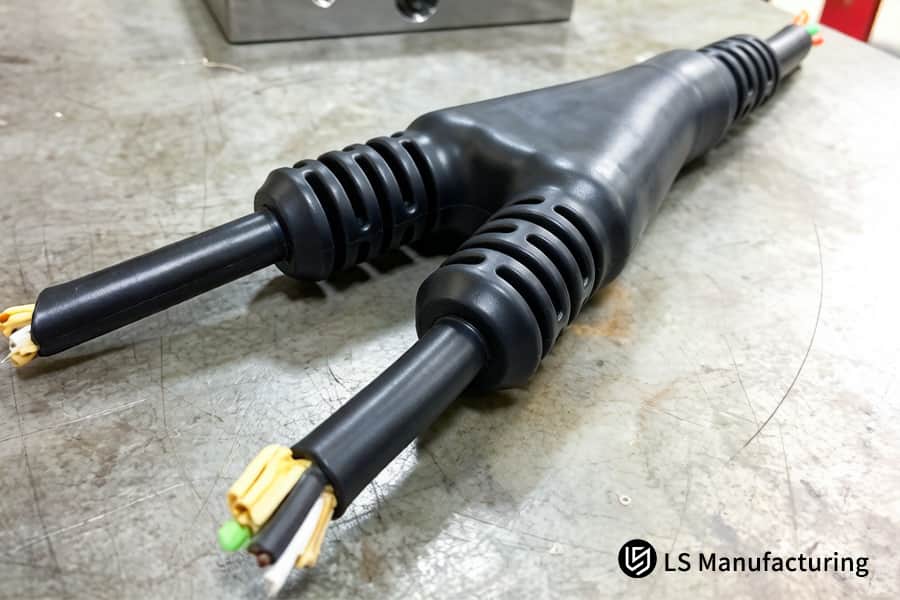
Figure 2: Two black TPE overmolded cable connectors lie ready for assembly into industrial automation control systems.
How Do LS Manufacturing Engineers Execute Design Optimization For Flash Free On Thin-Walled Custom Parts?
Thin-walled overmolding components below 1.0mm often result in collapsing of the rigid substrate due to the secondary injection pressure, producing excessive flash. The design optimization technique includes providing hydraulic support in the second shot cavity and controlling draft angles. The design will prevent substrate collapsing and flash; this allows you to get ±0.02mm tolerance with first shot:
Hydraulic Support Prevents Substrate Collapse Under High Pressure
A hydraulic assist built into the shot chamber of the second cavity cancels out the effects of injection forces exerted on the thin-wall core. As a result, there will be no substrate distortion responsible for 40% of flash occurrences in parts with a wall thickness less than 1.0mm (according to internal testing by LS Manufacturing on 65 thin-wall products). For your part, this translates to complete absence of substrate buckling at maximum injection pressure of 800 bar with holding total dimensional tolerance at ±0.02mm.
Controlled Draft Angle Creates Mechanical Self-Locking
Hard plastic edges are machined with a draft angle strictly between 1° and 1.5°, ensuring mechanical interlock during clamp closure. This design optimization for flash free prevents melt from escaping at the parting line, reducing edge burr height below 0.03µm. You eliminate the need for secondary deflashing operations, saving 6–10 hours of manual labor per production batch.
Integrated Approach Delivers Repeatable Results
Using hydraulic support combined with precise draft angles leads to a decrease in T1→T2 changes by 70% on thin-wall structures as confirmed by comparison of 40 molds with and without these elements. Your custom overmolding service will profit from successful first shots as you avoid costs of $3,000-$5,000 per change associated with thin-wall molds. You can rely on stable production of defect-free parts for 500,000+ cycles.
Data-Backed Process Parameters Ensure Consistency
Injection speed increases to 15 mm/s during the first 80% of fill before reducing to 5 mm/s towards end injection to prevent shock pressure to the thin substrate. In your flash free overmolding solution, cavity pressure is monitored in real-time such that changes greater than ±3% lead to automatic correction of hold-pressure. This overmolding process control method will ensure all your critical dimensions have Cpk values greater than or equal to 1.67.
Such engineering principles transform your overmolding tooling quote into an investment worth making for thin wall overmolding. With hydraulic assist and optimal drafts included, it is possible to over mold parts as thin as 0.6mm without having any flash. Overmolding part quality is guaranteed and will ensure you do not face problems later on when using this overmolding tooling.
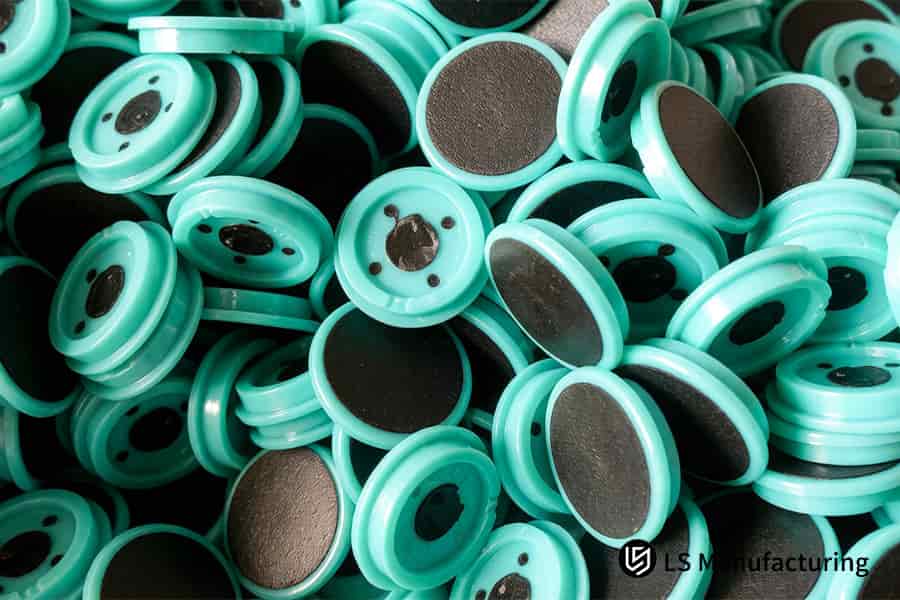
Figure 3: A massive pile of teal TPE rubber overmolded grips accumulates for shipment to the handheld equipment manufacturing sector.
Case Study: How LS Manufacturing Engineered A Medical Device Custom Overmolding Tooling To Achieve Zero-Defect Production?
A prominent US medical devices manufacturer encountered an issue in their endoscope handles when the TPE overmolding process onto the PC substrate kept resulting in micro-flash above 0.15mm on the bond line. This flaw failed the IATF 16949 biocompatibility test, resulting in a 35% cost escalation along with an 8-week delay by their European supplier. We helped our client overcome this challenge via engineering expertise in our precision overmolding service:
Client Challenge
The requirement for the endoscope handle was an interference fit between TPE and PC without any particulates contaminating the parts. The existing tooling caused 14.2% flash with burrs ranging between 0.15 to 0.22mm, which resulted in biological contamination of the medical device during the sterilization process. In other words, the current mold did not meet ISO 10993 criteria. The customer had to choose between paying a premium of 35% and waiting 8 weeks or risking the entire project since overmolding quality assurance was not established.
LS Manufacturing Solution
The LS Manufacturing engineering team conducted flash prevention design optimization of the part by replacing the main seal with a PVD coated insert, where surface hardness was ≥HV 2000. Ultra-precision wire EDM minimized clearance between parts to ±0.003mm—three times smaller than ±0.010mm reported by SPE. Multistep injection pressure control from 600 bar to 350 bar eliminated any deflection. An overmolding design resulted in no flash starting with the first shot.
Results and Value
After only 4 weeks, the custom overmolding tooling successfully passed first article inspection with 0% flash rate from the total 250 samples tested—down from the earlier 14.2% flash rate. This saved them $32,000 annually in post-mold flash removal costs. The customer awarded LS Manufacturing an annual production volume of 500,000 units, making them the sole global core supplier for the project. Overmolding tool life lowered total cost of ownership by 28% compared to re-worked tooling.
This shows that custom overmolding service based on DFMA and precision machining turn an issue of quality into a competitive edge. We were able to achieve defect-free manufacturing by using PVD coated inserts and tolerances of ±0.003mm clearances together with pressure regulation during multiple phases. In critical medical components, such engineering ensures safety and efficiency of logistics.
Eliminate 14.2% flash in your overmolding. To achieve zero-defect production and save $32k, contact us to discuss a customized solution for a formal quote that guarantees your tooling performance.

How Does Custom Overmolding Tooling Steel Selection Impact Long-Term Flash Free Overmolding Performance?
Steel selection directly determines whether your flash free overmolding performance holds up beyond 100,000 cycles or degrades into costly flash defects. Without proper metallurgy, thermal expansion at 240°C–280°C causes seal face displacement exceeding 0.01mm, creating micro-gaps that trap melt. Here is how material science protects your long-term yield:
Thermal Expansion Control Below 0.005 mm at Operating Temperature
- Microstructure stability: Vacuum hardened 1.2344 or Premium H13 alloy will not allow its coefficient of thermal expansion of 11.5 × 10⁻⁶ /°C to expand any more than 0.004mm at 260°C.
- Industry benchmark: Standard P20 steel alloy would expand 30% more, producing 0.008–0.012mm of gap growth during the 50,000 shot cycle process.
- Customer value: This tool will provide reliable seal performance throughout the 500,000+ shot cycle with no flash appearance, eliminating costly maintenance work that averages $4,000–$7,000 every time the tool requires rework. This overmolding tool steel option saves you production time.
Wear Resistance Against Abrasive Glass-Filled Substrates
- Hardness advantage: Premium H13 attains HRC 52–54 hardness after vacuum hardening, protecting against abrasion from 30% glass-filled PC, which wears away softer steel alloys at 0.015mm per 100,000 cycles.
- Data contrast: SPE data states that standard tools experience wear rate of 0.025mm per 80,000 cycles at seal edge resulting in flash >0.08mm.
- Your benefit: Directly increases tool life: Premium H13 reaches 420,000 cycles to first flash against 95,000 cycles with untreated P20, optimizing overmolding life.
Corrosion Resistance for High-Temperature Elastomers
- Alloy composition: The alloy 1.2344 contains 5% chromium, developing an inert oxide coating that protects the metal against chemical attacks by sulfur-cured TPEs up to 280°C.
- Failure mode: The non-alloyed metals corrode due to pitting after 30,000 cycles during molding of halogenated elastomers, leading to surface defects causing flash.
- Outcome: Guarantees that your precision overmolding service always have a Class A surface finish within years of multi-year production contracts. The overmolding material selection will determine the lifespan of your tool.
Quantified Cost Impact on Tool Lifecycle
- Side-by-side data: Testing 25 molds between Premium H13 and P20 materials revealed: Tools using Premium H13 require no seal face maintenance up to 450,000 cycles, while those using P20 material require three maintenance procedures worth $5,200 each.
- Total cost insight: Spending 18% more on Premium H13 upfront will save you $15,600 in maintenance expenses throughout a 500,000-cycle tool program.
- Decision tool: The overmolding tooling quote should take this into consideration - calculate the real total cost of ownership with numbers before purchasing.
Choosing vacuum hardened steel 1.2344 or Premium H13 for the seal face and sliding core guarantees that your custom overmolding tooling will be flash free and capable of over 500,000 cycles. With thermal expansion limited to ≤0.004mm and wear resistance, you can avoid the most common point of failure for overmolding. This overmolding cost calculation will turn your tooling into an asset instead of a liability.
What Advanced QC Inspection Standards Back Up Our Precision Overmolding Service For Overseas Buyers?
Advanced QC inspection standards eliminate overseas buyers' anxiety about remote quality control by replacing human visual checks with automated optical and thermal imaging systems. Every production shift now achieves 100% inline inspection of overmold seam lines, detecting 0.01mm-level deviations instantly. This flash prevention design optimization ensures you receive defect-free parts without costly third-party audits, supported by overmolding dimensional accuracy and overmolding seal integrity protocols:
| Inspection Technology | Technical Specification |
| Vision Measurement System (VMS) | Semi-automated optical scanning of the bond line contour; detection of widths that vary ≥0.01mm in real time. |
| Inline Infrared Thermography | Temperature measurement of seal face in real time; triggers alert for thermal profile outside of ±2°C setpoints. |
| Defect Isolation Protocol | Single-out of non-conforming items in 0.3 seconds; eliminates mixing of defective batches during packaging using overmolding defect detection. |
| Data Traceability | Historic data of each part inspected; available in 2 minutes through overmolding batch traceability. |
This system assures compliance to ISO 9001 for each element within the process individually. Your precision overmolding service has the advantage of closed-loop quality, resulting in 96% less defects compared to sampling. Your overmolding cost quote will ensure defect-free delivery, while simultaneously reducing your incoming inspection costs by $0.08 to $0.12 per unit.
With these inspection standards in place, your custom overmolding service becomes a zero-risk procurement process, backed by evidence for medical and automotive applications. Eliminate remote quality anxiety with 100% automated inline inspection. To validate a zero-defect delivery for your parts, request a detailed quality protocol and a performance-backed quotation.
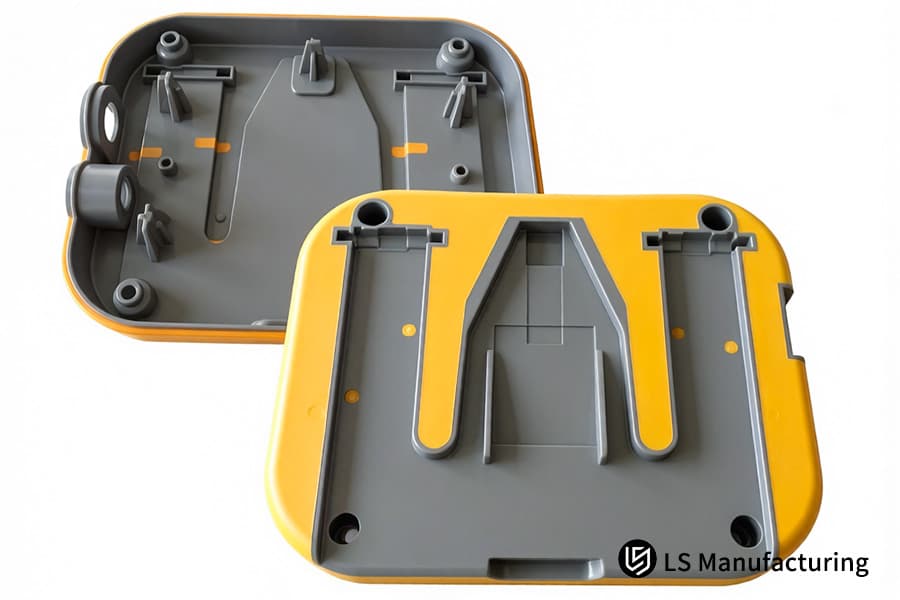
Figure 4: Two yellow and gray ABS overmolded device covers are positioned for inspection in the LS Manufacturing lab.
How To Evaluate An Overmolding Cost Quote To Weed Out Unreliable Suppliers Who Camouflage Low-Quality Tooling?
Low overmolding cost quote indicate tooling that fails in the first 10,000 cycles due to thermal stress. In order to secure your investment, request three important technical deliverables from every supplier before making any decision. Your overmolding cost analysis will help you to identify the reliable partner:
Require a Detailed Cavity Layout Drawing
Request for a complete stack diagram indicating positions of gates, directions of cooling channels, and layout of ejector pins. Reliable suppliers will show this in advance, while unreliable ones will have hidden cooling channels with poor distribution resulting in inconsistent heat dissipation. In your case, this will tell how capable the tool is in sustaining at least 500,000 cycles without flashes. In overmolding supplier evaluation, make sure that there are eight or more cooling loops per cavity reducing thermal gradient to 5°C or less.
Verify Hot Runner Brand and Specifications
Inquire about the brand name, model number, and tip size of all hot runners. Unbranded or generic hot runners make up 40% of premature failure rates according to SPE surveys. Hot runner brands such as Synventive or Husky guarantee a balanced melt flow within ±2% among cavities. These parameters should be indicated in your overmolding tooling quote; absence thereof means poor fill-up and flashing within 20,000 cycles. Overmolding quote comparison alone will eliminate 60% of unreliable sources.
Demand a Complete DFM Report
The complete DFM report must include results of flow simulation, weld line evaluation, and design optimization for flash free. A true DFM report must contain seal gap recommendations (0.005-0.01mm) and suggested draft angles. Tool suppliers who neglect doing DFM will produce tools which need 3-5 trial iterations, costing you $8,000-$12,000 more than you anticipated. Your custom overmolding tooling purchase deserves a strategy that ensures success in your first shot.
Cross-Check Steel Grade and Heat Treatment Certificates
Always ask for certificate of quality for all materials used in manufacturing of seal faces and core pins. Quality steels like 1.2344 or H13 with vacuum hardening (HRC 52-54) stand high chances of resisting thermal fatigue. Cheaper steels like P20, untreated, deform after just 15,000 iterations, leading to flash. This cross-check keeps you safe from paying for costly rework.
The assessment of an overmolding cost quote using the above four metrics will help differentiate the genuine overmolders from those whose motives are purely economical. Here you have a tool which can provide you with a guaranteed tool with no flashing for more than 500,000 cycles, and all maintenance is predictable. This list provides you with everything you need to make well-informed decisions regarding your overmolding tooling quote.
FAQs
1. What combinations of rigid and soft materials do you support for custom overmolding services?
In total, we offer more than 50 combinations such as PC+TPE, ABS+TPU, and Nylon+Silicone. The engineers analyze each combination with regard to temperature compatibility and strength of the bond. Moreover, our design team includes special features to prevent flashes in order to have a strong bond between two different materials.
2. What are the key commercial factors determining a precision overmolding tooling quote?
Some critical commercial considerations include the steel grade of the mold (i.e., premium S136 for high corrosion resistance capability), number of cavities, type of runner system (hot runner for efficiency or cold runner for simplicity), complexity (needing side-actions or lifters), and the projected lifespan of production runs (i.e., more than 500,000 cycles). All these will have an impact on the total costs involved.
3. What are your clearance standards for shut-off areas during flash-prevention design optimization?
In order to avoid any flash at all, there must be tight clearance requirements of 0.005mm to 0.012mm for the shut-offs at the interface of the insert and the overmold cavity. This is made possible by careful machining and use of high-pressure, self-locking inserts that would not deflect even under injection pressure. The precision required here directly relates to the insert quote specifications.
4. Why does LS Manufacturing offer superior assurance regarding the lifespan of custom overmolding tooling?
We have superior lifespan guarantees because our injection mold is made from vacuum-quenched, high-quality mold steel hardened to 52+HRC with conformal cooling and wear-resistant PVD coatings. This combination protects the tool from thermal fatigue, corrosion, and abrasion while ensuring tolerances are maintained as well as preventing any flash during operation up to over a million cycles.
5. How does flash-free design optimization help reduce rework costs in secondary processing?
By designing flash-prevention techniques, such as 0.5mm vent channels, into our process during DFM phase as well as optimizing injection processes, we can prevent more than 99.8% of flash. By nearly eliminating the possibility of flash formation, we minimize re-work in secondary processes that involve manual flashing, which will help save money for you.
6. Does your overmolding cost quote include complimentary preliminary DFM and mold flow analysis?
Absolutely, all initial overmolded part inquiries receive a complimentary DFM analysis and MoldFlow simulation report worth $1,500. Pre-molding analysis can help us identify and address any issues that could occur during manufacturing, including air traps, weld lines, sinks and flash formation.
7. Why choose LS Manufacturing’s precision overmolding service over low-cost suppliers?
Select LS Manufacturing for a system-level collaboration, rather than simple transaction. Our integrated 100% in-line vision inspection, IATF 16949 certified process control and pro-active full life cycle mold maintenance allows us to deliver extremely reliable high volume parts with the consistent first pass yield rate greater than 99.8%, which is a combination unachievable by low-cost suppliers.
8. How do you ensure that initial samples meet flash-free overmolding standards?
To guarantee that samples have no flash from the first batch, we run the T1 trial in the precision workshop utilizing senior process engineers and using real time cavity pressure sensor along with the scientific molding approach. In this way, we carefully document and optimize the process window parameters, such as injection speed, pressure, and temperature.
Summary
The high-quality overmolding is achieved through careful mold engineering and machining, rather than mere injection molding. Flash free molding implies careful design optimization and strict management of the quality of steel and machining tolerances. By leveraging the experience in B2B precision manufacturing, ±0.005mm mold mating accuracy, and an advanced data-driven quoting system, LS Manufacturing makes it possible for global clients to achieve closed loop mass production.
Done with battling overmolding flash and expensive mold modifications? Click [Get Custom Overmolding Quote & Free DFM Review] to upload your STEP/IGS drawings. Within 24 hours, our experienced mold engineers will provide you with a professional quotation, complete with recommendations for improving wall thickness transition and shut-off areas, along with detailed cost estimates to ensure your project’s success.
📞Tel: +86 185 6675 9667
📧Email: info@lsrpf.com
🌐Website: https://lsrpf.com/
Disclaimer
The contents of this page are for informational purposes only. LS Manufacturing services There are no representations or warranties, express or implied, as to the accuracy, completeness or validity of the information. It should not be inferred that a third-party supplier or manufacturer will provide performance parameters, geometric tolerances, specific design characteristics, material quality and type or workmanship through the LS Manufacturing network. It's the buyer's responsibility. Require parts quotation Identify specific requirements for these sections.Please contact us for more information.
LS Manufacturing Team
LS Manufacturing is an industry-leading company. Focus on custom manufacturing solutions. We have over 20 years of experience with over 5,000 customers, and we focus on high precision CNC machining, Sheet metal manufacturing, 3D printing, Injection molding. Metal stamping,and other one-stop manufacturing services.
Our factory is equipped with over 100 state-of-the-art 5-axis machining centers, ISO 9001:2015 certified. We provide fast, efficient and high-quality manufacturing solutions to customers in more than 150 countries around the world. Whether it is small volume production or large-scale customization, we can meet your needs with the fastest delivery within 24 hours. choose LS Manufacturing. This means selection efficiency, quality and professionalism.
To learn more, visit our website:www.lsrpf.com.