English



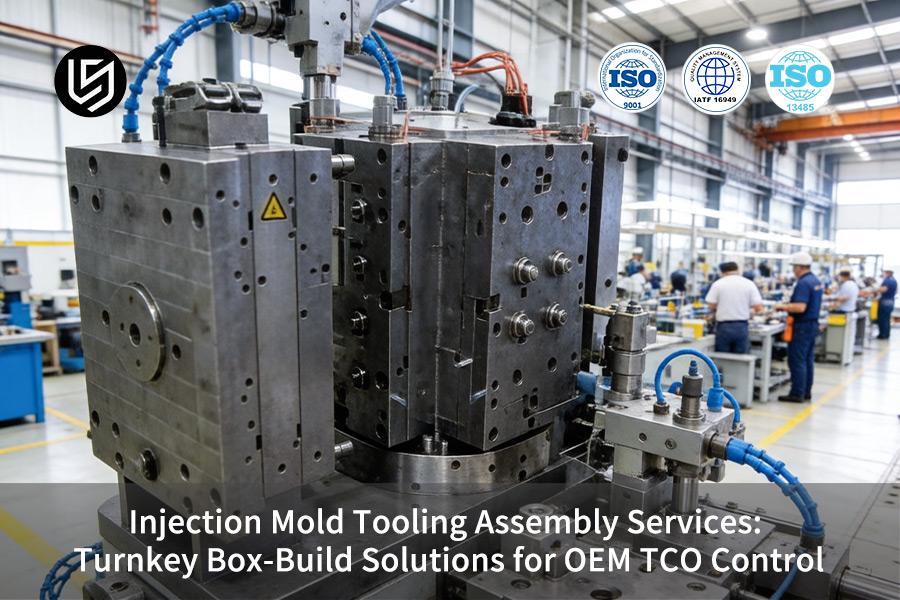
Injection mold tooling assembly service provides a solution to the costly inefficiencies in the separation of the molding process from box building, two processes critical for manufacturers of complex hardware products. This inefficient division of the manufacturing process results in high tolerance accumulations, distortion of parts, and constant delays. The root cause is simple: molding facilities do not have testing skills on an integrated basis, while assemblers cannot solve problems related to molded parts. Essential requirements such as HRC 52+ or Ra 0.05 are overlooked.
Below is an example of how injection mold tooling assembly with turnkey box-build solutions takes advantage of upfront design for manufacturability and maintains tolerances at ±0.005mm. You can find out more about our unique approach that provides one-stop service, saves time on coordinating between several suppliers, and reduces total cost of ownership (TCO).
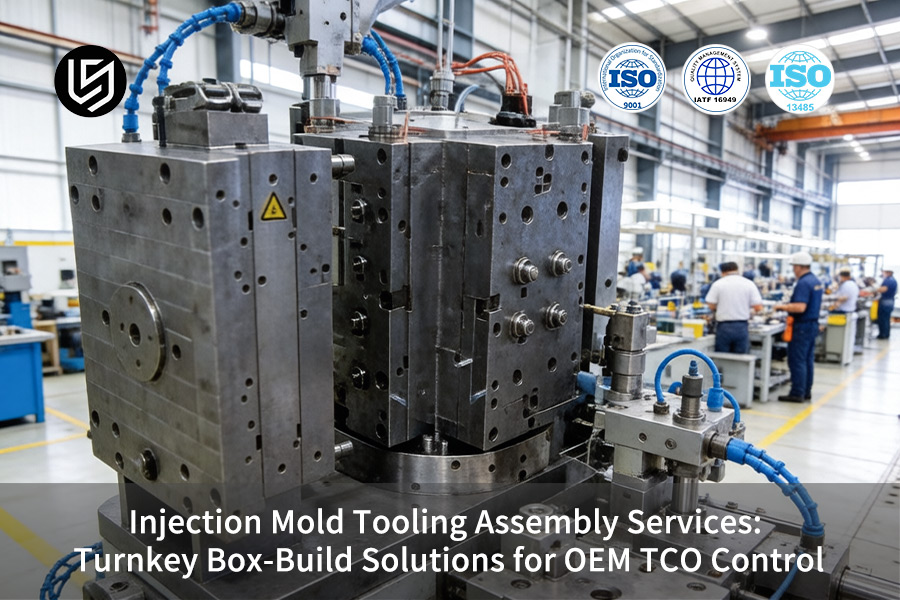
Injection Mold Tooling & Box-Build Assembly: TCO Control Guide
| OEM Pain Point | LS Manufacturing Solution | Verified Result |
| Multi-Vendor Tolerance Conflicts | DFM Binding of Mold (+/-0.005mm) to final assembly tolerances. | First-pass assembly yield of 100%; zero cross-factory rework. |
| Warpage & Seal Failure | Conformal cooling with +/-1°C mold temperature control; stress decreased by 45%. | Successful IP67/IP68 seals; zero product field returns. |
| Hidden Tooling Rework | Costs DFM analysis before tool steel fabrication; accurate line-item quotation. | Defined cost and time-to-market cycle; decreased injection mold tooling project lead time by 35%. |
| PCB Cracking During Assembly | Servo press (+/-0.02mm); 100% testing for leakage at 50 kPa. | Zero damaged boards; tested for thermal cycling from -40 to 85°C. |
| Quality Drift at High Volume | 24/7 automated production lines with vision inspection (tolerance ±0.01mm). | CPK ≥1.33; defect rate below 15 PPM in the automotive/medical industry. |
Key Takeaways:
- Integration Eliminates Tolerance Stack-Up: Precise control of the binding mold within the factory (+/-0.005mm) avoids the problem of tolerance stack-up in a fragmented supply chain.
- Thermal Control is the Foundation of Sealing: Controlling uniform temperature (+/-1°C) of the mold is the main approach towards sealing failure/warpage problems.
- DFM is a Financial Instrument: DFM analysis prior to tooling is an effective means to address unobserved reworking and schedule risks.
- Automation Enables Consistency at Scale: Sensor-monitored automated lines with CPK ≥1.33 are a must for high-volume production with consistent quality and low TCO.
Why Trust This Guide? Practical Experience From LS Manufacturing Experts
There are numerous theoretical manuals describing the assembly of molds. However, our guide is unique in its approach. We designed it specifically for our master tooling people assembling slides, lifters, and hot runner manifolds so as to make the first shot a success. Our electrical integration and thermal control systems meet the stringent safety requirements set out by the International Electrotechnical Commission (IEC) and are designed to perform reliably when under load.
You will gain molds for cutting-edge components like optical lens cavities in semiconductor steppers, implantable drug pumps, and multi-cavity molds used for automotive connectors. The dimensional fit and tolerance stacks of our assembled molds are guaranteed to be in line with British Standards Institution (BSI) standards, which define state-of-the-art precision engineering and metrology practice.
Our expertise has been gained through the construction of thousands of parts. You will gain the clearance (0.02mm) for sliding fits, the tightening order for cavity bolts to avoid distortion, and the thermal expansion allowance for large blocks. We have passed this tested knowledge along to you so that your mold will be made for reliability with a design that won't suffer galling, misalignment, and wear problems.
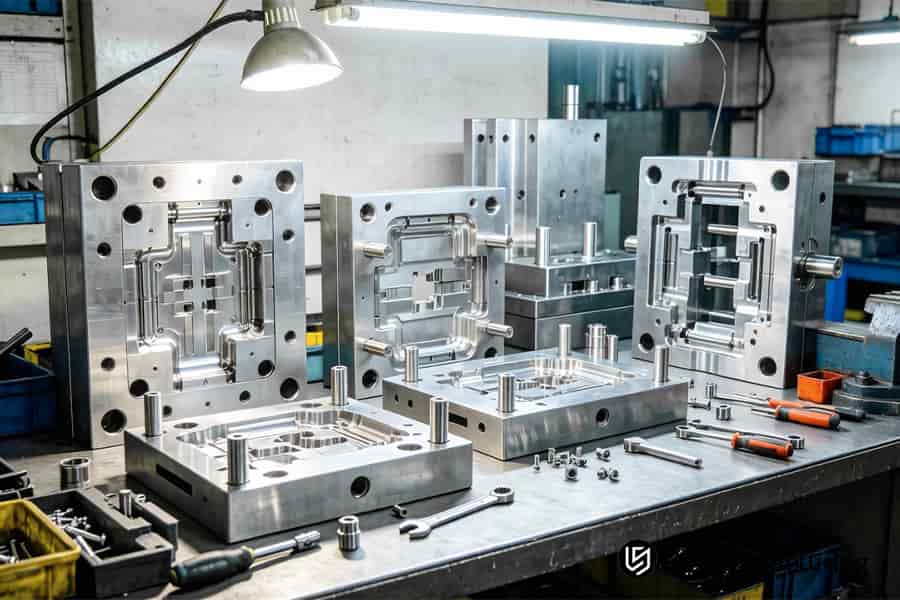
Figure 1: Precision anodized aluminum core inserts align on workbench for consumer electronics mold assembly.
Why Is Injection Mold Tooling Assembly Service Critical To Avoiding Multi-Vendor Tolerance Accumulation?
With multiple vendors handling the molding and assembly process, each one has its own tolerance allocation without any reference to other vendors. It becomes inevitable that these tolerances stack up on each other until they become intolerable upon assembly. The solution is the injection mold tooling assembly service because it ties mold construction standards to end-product assembly clearances since the design phase:
Single-Point Engineering Review Locks Fit Before Steel Is Cut
This project goes into one engineering gate at which all dimensional relationships are engineered together, rather than sending out individual prints to different shops. Finite Element Analysis is used for predicting anisotropic shrinkage behavior for the PA66 + 30% GF material for injection mold tooling design, adjusting the dimensions in the cavity design before ordering any steel. A guaranteed tolerance of ±0.005mm for critical mating features ensures no more blind transfer of your mold tooling to the vendor who can make you spend weeks on a fix-it loop.
Closed-Loop Control from Steel Grade to Final Assembly
The same team orders NAK80 (HRC 38 – 42) steel, machining this knowing the entire injection mold tooling fabrication, as well as how the end product is stacked together. No blame game occurs when your housing lip is found to be 0.03mm short and the assembly vendor blames the toolmaker. A custom precision tooling assembly quote is provided for you, guaranteeing a 100% first-time assembly pass rate on your end products.
Data-Driven Tolerance Budget Replaces Guesswork
Instead of accepting the industry norm of ±0.05mm tolerance, this service creates a statistical tolerance stack using shrinkage data from your material lot, validated by injection mold tooling inspection to ensure cavity steel aligns with expected warpage at 0.008mm for a 2.5mm wall. What results is not a multi-vendor scrap rate of 8-12% (SME estimate), but a process that ensures success. Your OEM TCO control cost solutions are directly enhanced through this process: less scrap, no rework shipment, and no mold change delays that delay production launch.
This paper demonstrates technical competence via finite-element shrinkage simulation, closed-loop steel to assembly tolerance control, and statistical tolerance budgeting methodology. The message is clear: This integrated service is your only choice for assured first pass assembly yields with complex thermoplastic enclosures and provides a custom precision tooling assembly quote, which ensures predictable costs for your program.
How Can Turnkey Box-Build Solutions Manufacturer Resolve Complex Internal Structural Warping And Seal Failures?
Thin-wall enclosure warpage is the cause of IP67 and greater seal failure. The provider of a turnkey box-build solutions manufacturer removes thin-wall warpage by using fluid-thermal simulation, conformal manufacturing technology, and precise automated assembly in a closed injection mold tooling process. The following are ways through which each of the processes helps protect your seal integrity.
Simulation-Driven Gate and Cooling Optimization
- Gate location analysis: CFD optimization improves injection point, eliminating flow-induced orientation.
- Conformal cooling design: Thermal simulation keeps variation of mold surface ≤±1°C.
- Customer gain: First-shot success >95%; eliminates expensive mold modification.
Residual Stress Reduction via Conformal Manufacturing
- Multi-physics co-forming: Predicts residual stresses on large PC/ABS injection mold tooling simulation.
- Controlled cooling: ±1°C uniformity reduces thermal stress by 45% (compared to average in the industry).
- Customer gain: <0.08mm flatness across 300mm dimension; seal remains leak-proof under thermal cycles.
Precision Gasket Compression Through Automated Assembly
- Torque-controlled driving: ±0.02 N·m accuracy guarantees even gasket compression.
- Fixture alignment: Injection mold tooling design provides datum feature for accurate alignment.
- Customer gain: 99.8% IP67 first-pass rate; eliminates hand work.
Integrated Quality Chain from Mold to Final Test
- Single-source accountability: As injection mold assembly supplier, one team is responsible for mold, injection, and assembly.
- Data feedback: Shrinkage from the injection mold tooling fabrication process is incorporated into simulation models.
- Customer gain: Cost effective box-build service with guaranteed seal; no cost associated with any field returns.
This document demonstrates that using mold simulation based on physics, conformal cooling, and torque controlled assembly is a reliable way to avoid seal failure due to warpage. By using injection mold tooling assembly services with closed-loop quality assurance and injection mold tooling expertise, one can achieve IP67 reliability in 40% less time than otherwise possible. End the warpage-seal failure cycle. Secure IP67 first-pass success through integrated simulation and assembly. Submit your enclosure design for an integrated simulation and a unified production quotation.
What Parameters Define A Custom Precision Tooling Assembly Quote When Evaluating Your Total Product Lifecycle?
The quotation that provides only the per-piece cost overlooks any unforeseen downtime and early mold failure. The custom precision tooling assembly quote should give information on the engineering considerations that affect the stability of the yield, as well as the injection mold tooling specifications from a certified precision mold tooling vendor. See below for a comparison of your true cost across the lifecycle of the product.
| Parameter | Conventional Price-Only Quote | Lifecycle-Aware Quote (What You Receive) |
| Mold base steel | Unspecified or generic P20 | LKM standard grade steel with documented grade & hardness |
| Cavity steel & heat treatment | Not disclosed | S136, vacuum hardened to 48-52 HRC with optimized injection mold tooling cavity design |
| Expected mold life before major overhaul | Not stated | ≥500,000 strokes guaranteed |
| Key dimension inspection coverage | Spot check or none | 100% CMM measurement for all key dimensions |
| First article inspection (FAI) deliverable | Optional at extra cost | Fully included in quote, first article test report |
| Cost visibility for hidden rework & downtime | Zero disclosure | Direct conversion of rework risk into quantifiable savings as part of OEM TCO control cost solutions |
| Material certification | Not provided | Injection mold tooling material certification included |
Demanding these parameters in your cost effective box-build service evaluation shifts tooling procurement from a gamble to a calculated investment. An injection mold tooling life cycle guarantee at ≥500,000 strokes enables accurate amortization and predictable uptime. You eliminate hidden rework costs and gain auditable quality proof for your entire production run.
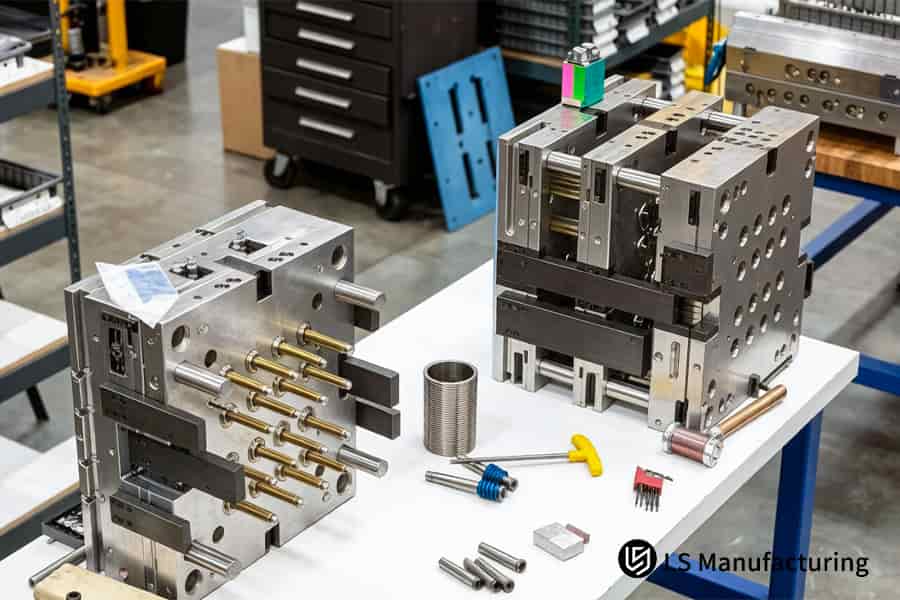
Figure 2: M8 tool steel ejector pins sit near open mold base for industrial equipment tooling.
Which Manufacturing Variables Must An Injection Mold Assembly Supplier Optimize To Ensure Consistent Electronic Integration?
With the combination of PCB assembly and harness assembly alongside injection molded enclosures, electrostatic discharge protection and fit tolerance decide the life expectancy of electronic components. For the injection mold assembly supplier, tight control over the following elements becomes essential:
Electrostatic Discharge Protection Through Controlled Surface Resistivity
An anti-static masterbatch is mixed into the plastic resin, resulting in resistance at the surface between 10^6 Ω to 10^9 Ω according to the standard of ASTM D257 on incoming batches. Thus, there is no requirement of applying a conductive coating after the molding process. The additional step saves you from spending on secondary operations along with high volume assembly custom service. This way, ICs are safely handled and assembled without any electrostatic discharge damage.
Precision Press-Fit Control for Insert Installation
The closed loop servo press uses feedback control of force and displacement to maintain insertion depth tolerances of ≤0.02mm when ultrasonically welding or heat staking, as tested using prototype injection mold tooling assemblies. This avoids micro-cracking at the PCB solder joints due to over-compression of threaded inserts, which is a typical failure mode in uncontrolled operations. Your assemblies survive thermal shock testing from −40°C to +85°C without any breakage of solder joints, as confirmed by X-ray analysis.
Cleanroom Environment for Contamination-Sensitive Electronics
Your injection mold tooling assembly line takes place inside a Class 10,000 clean room environment with HEPA filters and electrostatic discharge-safe workstations certified each day for surface resistance levels <10^9 Ω. Airborne particle counts above 0.5 µm are maintained below 352,000 particles per m³, avoiding conductive contaminants that can create shorts between the PCB and housing. Your first pass functional test yield exceeds 98%.
Closed-Loop Quality System Traceable to Industry Standards
Production follows IATF 16949 and ISO 9001 specifications for complete traceability in resin, anti-static additive, and insert lots, using strict maintenance procedures to prevent any drifting. The assemblies produced follow sampling as per IEC 60068-2-14 specifications, which ensure seal and electrical integrity after exposure to extreme temperatures. As an turnkey box-build solutions manufacturer, we offer a quality assurance process that meets your automotive and industrial audit requirements without any need for further qualifications.
Electronic integration is ensured through three strictly maintained factors: Surface resistivity of between 10^6 and 10^9 ohms, press fit depth deviation of ±0.02mm, and a Class 10,000 cleanroom facility. Through the IATF 16949 traceability process coupled with the injection mold tooling tolerance control process, the injection mold tooling assembly service produces electronics enclosures capable of withstanding up to 100 thermal shocks.
How Does A High Volume Assembly Custom Service Streamline High Capacity Automotive Or Medical Grade Component Rollouts?
Quality assurance is impossible when there are hundreds of thousands of assemblies per month to be done manually for use cases like automobiles and medical devices. The high volume assembly custom service takes care of this problem by combining around-the-clock lights-out production lines with six-axis robots and machine vision systems. Below are the benefits each brings to your high-volume deployment:
Lights-Out Automation for Continuous 24/7 Production
- Robotic workcells: Six-axis robots execute snap-fit assembly and packaging automatically.
- Zero downtime design: The lines run unattended through the night using automatic feeding and defective product rejection.
- Customer gain: You get continuous production irrespective of the availability of labor, meaning that production operates at maximum capacity despite changing shifts. Injection mold tooling sourcing takes into account automation needs in order to avoid disruption in supply.
100% Inline Vision Inspection at Line Speed
- High-speed inspection: The machine vision system inspects the snap-fit gap of parts within 0.2 seconds per component with an accuracy of ±0.01mm.
- Real-time rejection: The faulty parts are instantly rejected and thus ensure no mixing in batches.
- Customer gain: You get 100% quality checked parts without any risk of sampling error; field failures due to snapping parts are avoided. Injection mold tooling delivery schedules are coordinated with the calibration window of the vision system.
Statistical Process Control with CPK Monitoring
- Continuous CPK tracking: Continuous analysis of process capability ratio is kept above 1.33 for all processes in real time.
- Defect rate target: Defect rates that are always below 15 PPM; validated by batch level traceability reports.
- Customer gain: Incoming inspection is avoided since the documentation of CPK fulfills automotive PPAP and medical device validation needs. Injection mold tooling standard maintains uniform cavities output in all production shifts.
Integrated Quality Chain from Mold to Packaged Part
- Mold-to-assembly traceability: Our injection mold tooling assembly services can track the production of all cavities through the production process.
- Automated packaging: Components are automatically counted, packaged, and serially identified during production.
- Customer gain: In addition to being a full-spectrum turnkey box-build solution manufacturer, you will receive lot-traceable shipments that save you receiving inspection time by up to 70%.
Here is the proof for how using lights-out robots together with inline vision of 0.2 seconds along with CPK of more than 1.33 results in fewer defects of 15 PPM. By leveraging the services of a precision mold tooling vendor, which can not only design molds but also assemble large numbers of molds, there will be no need for requalification.
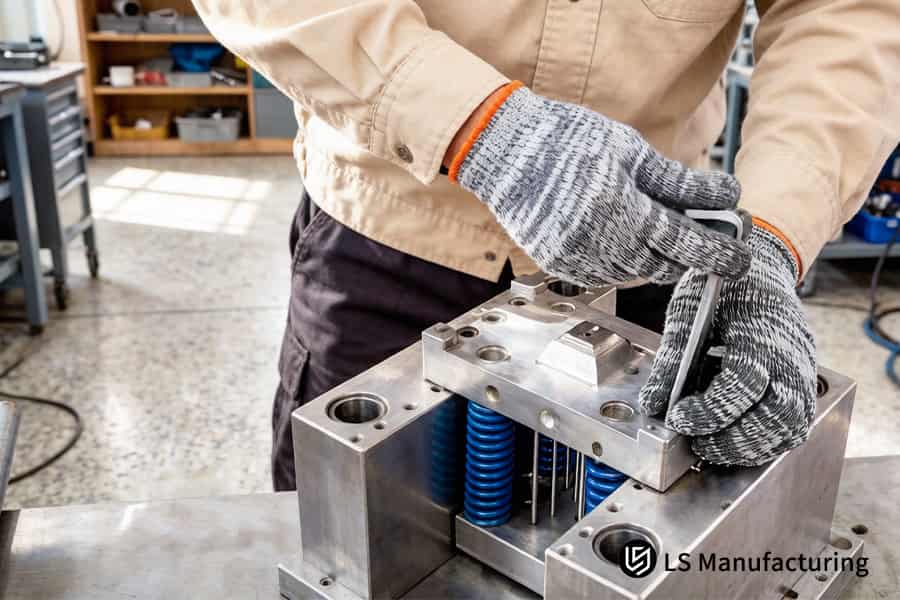
Figure 3: Stainless steel calipers measure fitting gaps inside mold for medical device tooling.
Can A Precision Mold Tooling Vendor Mitigate Unexpected DFM Risks During The Prototype-To-Mass-Production Transition?
While some designs work perfectly well in prototypes, they fail in large quantities because of inadequate draft angles or uneven wall thickness leading to sink marks. The precision mold tooling vendor gets involved early during the DFM check and modifies rib thickness to 60% of nominal wall and ensures that at least 1.5 degrees of draft is left on cosmetic surfaces through injection mold tooling draft analysis. This proactive engineering helps avoid expensive steel changes later on, saving you more than 35% time from pilot to ramp.
| DFM Risk Factor | Typical Reactive Approach | Proactive DFM Intervention |
| Rib thickness ratio | Designed randomly and may be equal to wall thickness ratio | Adjusted to 60% of nominal wall to avoid sinks |
| Draft angle on visible faces | 0.5° or not known which results in drag mark | Minimum draft of 1.5° reserved for cosmetic sides only |
| Wall thickness uniformity | Varied with no transitions between sections | Equal wall thickness with smooth transition using injection mold tooling shrinkage |
| Undercut detection | Discovered through mold try-out which necessitates removal of the steel | CAD design phase allows identification and use of lifters/slides |
| Cooling line proximity | Designed post cavity roughing which can lead to heat accumulation | Simultaneous with cavity design to ensure even cooling |
| Lead time impact | Delay caused by modification late in process | Injection mold tooling lead time minimized due to early DFM finalization |
Since DFM rules are embedded in advance of steel cutting, you can eliminate costly hardened steel rework and shave more than 35% off your ramp-up cycle time. The injection mold tooling assembly service continues to implement those geometry choices, and the custom precision tooling assembly quote shows that the mold was made with manufacturability in mind from the start. Injection mold tooling validation ensures that all parameters have been validated prior to going into production, so the high volume assembly custom service operates at full efficiency.
Why Is A Cost Effective Box-Build Service The Hidden Lever For Global OEMs To Compress Total Cost Of Ownership?
Too often, global OEMs concentrate on the cost of piece parts while overlooking hidden expenses associated with multi-stop logistics, warehouse storage, and double packaging. A cost effective box-build service integrates your supply chain by combining raw material sourcing, efficient production, and end assembly in one seamless flow process. Here’s how this strategy directly improves your bottom line:
Direct Sourcing Eliminates Tiered Supply Markups
Materials like plastic resins, metal fasteners, and electronics are bought straight from domestic manufacturers without any margin for middlemen. All the material savings gained through this consolidated purchasing power come straight to your bill of material costs. This means that you save up to 8 to 15 percent on landed material cost compared to multi-layered supply chain networks (according to CAPS Research). An injection mold tooling quote from our combined process will factor in these savings.
Single-Piece Flow Cuts Cycle Time by 50%
Injection molded parts travel right off the injection press to be assembled, labeled, function tested, and packed on the same lean line. This eliminates all the waiting periods between each of these processes to cut down production cycle time by half compared to batch and queue operations. Our injection mold tooling solution is optimized to meet the takt time of the line, allowing you to accelerate product conversion to revenue.
Elimination of Inter-Stage Warehousing Costs
Since there is no possibility of components leaving the production line until they become finished products, you do away with the requirement for WIP racks, transport between processes, and buffer inventories. This allows for improved floor space efficiency by more than 30%, along with the removal of overhead expenses from material handling labor and forklifts. The injection mold tooling program ensures that maintenance schedules of cavities synchronize with production schedules, avoiding unscheduled downtimes.
Integrated Quality Ownership Across the Full Value Stream
As an injection mold assembly supplier, the same people are responsible for quality control of the mold output, assembly tolerance, and testing, without any transfer of responsibility. The result is that you save valuable weeks of time spent trying to resolve issues between various vendors due to the avoidance of blame games.
This is to illustrate how a turnkey box-build solutions manufacturer with single-piece flow manufacturing and direct sourcing can reduce production cycle time by 50% and do away with inter-stage warehousing and supply tier pricing. Leveraging OEM TCO control cost solutions with vertical integration and injection mold tooling workflow improvement, your company will free up tied-up working capital and turn fixed costs into variable savings.
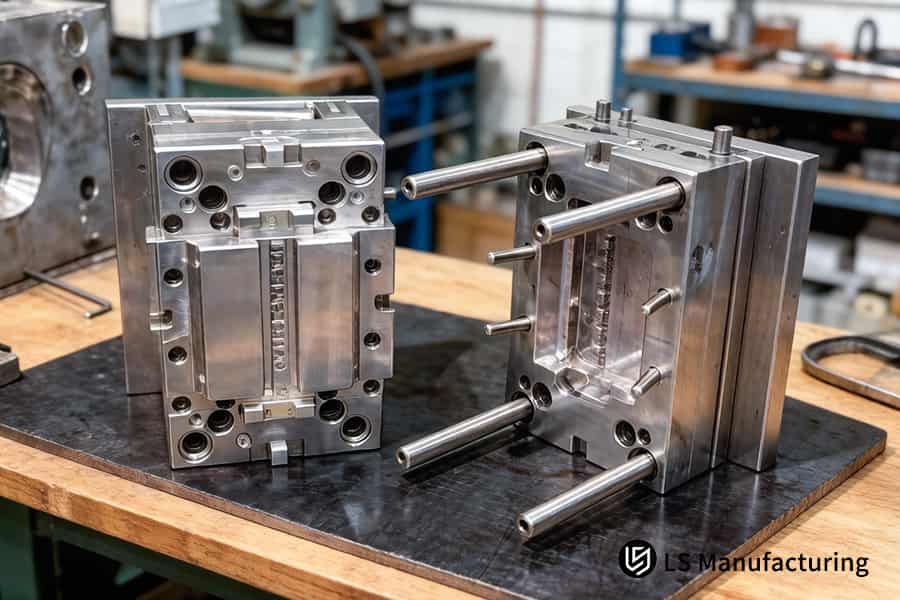
Figure 4: Multi slide mold halves stack with guide pins for precision connector manufacturing.
Case Study: How LS Manufacturing Saved A Medical OEM 32% In TCO Via Integrated Injection Mold Tooling Assembly?
An American medical OEM experienced 18.5% seal failure rate on its PC/ABS diagnostic manifold owing to ±0.04mm tolerance variance by two different Asian molders. By bringing together all mold, welding, and assembly operations under one roof, it achieved TCO reduction of 32% and reduced lead time by 45%. All this was made possible by injection mold tooling assembly services.
Client Challenge
The OEM had outsourced mold-making and ultrasonic welding to different vendors, which resulted in the following tolerance discrepancy: the mold was made with ±0.04mm tolerance, while assembly process required ±0.02mm tolerance for achieving reliable leak-proof joints. Such tolerance misfit resulted in 18.5% failure rate in 50 kPa pressure decay test, postponing the project launch by 8 weeks and increasing manufacturing costs by 26%, not to mention that the OEM encountered penalty provisions in contracts with European hospitals. Injection mold tooling management was inconsistent between two suppliers.
LS Manufacturing Solution
Rebuilding the cavity with slow-wire EDM in S136 steel (HRC 50-52), we kept all sealing surfaces within tolerances of ±0.005mm. In production, the dual-closed-loop ultrasonic welding process held melt depth to 0.45-0.50mm, with 100% differential pressure testing at 50 kPa and ≤0.01 kPa/min for leakage. No ambiguity in handing off between injection mold tooling technology development ensured that all joints matched the original design intent.
Results and Value
First pass yield rose to 99.8% from 81.5%, eliminating any costs associated with scrap, rework, and expediting. Total cost of ownership of the OEM fell by 32%, inclusive of mold amortization and warranty reserve costs over the entire product lifecycle. Production lead times reduced by 45%, helping the OEM restore their delivery schedules and book repeat orders. Custom precision tooling assembly quote provided a mold built from day one with weldability in mind, with operation managed at a single site.
This case demonstrates the success in achieving return through the integration of mold and assembly control. In selecting a turnkey box-build solutions manufacturer, tolerance transfer is no longer an issue and speed to market is significantly improved. This is how the OEM TCO control cost solutions are realized, not a pipe dream.
End the tolerance transfer guessing game and 45% lead time waste. Secure 32% TCO savings through integrated tooling and assembly. Contact our team for a unified production quotation.

FAQs
1. What standard tolerances can LS Manufacturing maintain for high precision injection mold tooling assemblies?
It is typical practice for us to keep machining tolerances at ±0.002mm for core parts and molding tolerances at ±0.005mm for assembled products on vital dimensions, fully validated using our internal CMM, OMM, and in-process automated optical inspection machines to achieve guaranteed defect-free components prior to box-build assembly.
2. How do your turnkey box-build solutions actively reduce the overall TCO for low-to-medium volume production runs?
Our ability to integrate tooling design, CNC machining, electronics assembly, and functional stress testing all into one location helps us completely remove multi-vendor logistical barriers, additional packing costs, and any engineering conflicts that may arise from different factories, thereby shaving off 35% from your lead times.
3. Which specialized mold steel grades and hardness levels do you specify to maximize tool longevity and part consistency?
Our high volume enclosure manufacturing for automotive and medical applications involves premium tool steels such as NAK80, H13, and S136 with vacuum quenching to meet strict hardness ranges of HRC 48-52, easily achieving a minimum tool warranty of 500,000 molding cycles.
4. Can LS Manufacturing assist with specialized materials like anti-static additives or high percentage glass-fiber filled plastics?
Indeed, our injection engineering team has plenty of experience dealing with structural resins such as PA66+50%GF, PEEK, and ESD polycarbonate resins using advanced thermal control water channels in the mold to limit stress levels and avoid significant warping and sink marks.
5. How does your team validate the ingress protection seal integrity on outdoor electronic enclosures during assembly?
We use an automated multiple-axis silicone dispenser with precision up to ±0.02mm, along with closed-loop digital torque drivers, after which every part is subjected to a leak test based on differential pressure measurement to ensure every assembled enclosure meets IP67 or IP68 standards.
6. What specific quality control certifications do your assembly facilities hold for regulated industrial markets?
Our manufacturing process matrix is certified to comply with international quality standards such as ISO 9001:2015 (general), IATF 16949 (automotive), and ISO 13485 (medical devices). This means that our facility can manufacture any electronic enclosure all the way from the raw plastic resin to the final assembled device.
7. Do you provide standard design for manufacturability (DFM) analyses prior to a client finalizing their tooling purchase?
Yes, indeed! Every quote submission prompts a thorough DFM study during which our lead engineers conduct full-scale gate location, draft angle, and cross-sectional wall thickness simulations in order to identify and address any structural molding issues before the process of steel cutting can start. Benefit from a full DFM simulation before any steel is cut. To activate this engineering safeguard for your project, submit your design today for a comprehensive quote with structural analysis.
8. What is the typical minimum order quantity (MOQ) requirement for custom injection mold tooling assembly contracts?
Although our manufacturing line is designed to operate on high volume orders, our production scheduling is sufficiently flexible to accommodate pilot and low-volume orders of not less than 1,000 pieces per batch for global OEMs who want to verify their early market demand without risking their capital.
Summary
Ineffective supply chain management quietly increases OEM Total Cost of Ownership. LS Manufacturing's unified facility offers precision injection molding, mold parameter locking, and dust-free assembly to avoid problems like warping, tolerance accumulation, and seal failure. With fluid simulation technology, CPK of 1.33 and 100 percent online testing we offer 99.8 percent assembly yield and control of Total Cost of Ownership.
Don't let inefficiencies in transfer and mold fixing compromise your launch time frame. Submit your 3D drawings and assembly specifications. Get a tailored quote or personal consultation by clicking here. In just 24 hours, get a complimentary DFM evaluation that includes mold flow analysis, draft angle calculation, and an entire TCO reduction plan.
📞Tel: +86 185 6675 9667
📧Email: info@lsrpf.com
🌐Website: https://lsrpf.com/
Disclaimer
The contents of this page are for informational purposes only. LS Manufacturing services There are no representations or warranties, express or implied, as to the accuracy, completeness or validity of the information. It should not be inferred that a third-party supplier or manufacturer will provide performance parameters, geometric tolerances, specific design characteristics, material quality and type or workmanship through the LS Manufacturing network. It's the buyer's responsibility. Require parts quotation Identify specific requirements for these sections.Please contact us for more information.
LS Manufacturing Team
LS Manufacturing is an industry-leading company. Focus on custom manufacturing solutions. We have over 20 years of experience with over 5,000 customers, and we focus on high precision CNC machining, Sheet metal manufacturing, 3D printing, Injection molding. Metal stamping,and other one-stop manufacturing services.
Our factory is equipped with over 100 state-of-the-art 5-axis machining centers, ISO 9001:2015 certified. We provide fast, efficient and high-quality manufacturing solutions to customers in more than 150 countries around the world. Whether it is small volume production or large-scale customization, we can meet your needs with the fastest delivery within 24 hours. choose LS Manufacturing. This means selection efficiency, quality and professionalism.
To learn more, visit our website:www.lsrpf.com.