English



CNC rapid prototyping costs present a major control challenge, with quotes for a simple aluminum housing ranging inexplicably from ¥1,500 to ¥4,000. We are forced to pay a high "hidden tuition" per iteration because of this opacity, and going for the lowest quote usually backfires when the parts fail the functional tests and the delay cycles, inflating the total project costs by 30% or even more.
The answer is a clear framework that goes beyond unit price and manages the real "Total Validation Cost." We deliver that by a reliable triad of cost dissection, control tactics, and partner selection, therefore, equipping you with the tools such as a 6-dimension vendor checklist that helps to make a prototype budget and on schedule.
CNC Rapid Prototyping Costs: Quick-Reference Guide
| Cost Factor | Insight & Strategy |
| Primary Cost Drivers | Machine time, material type/volume, and CAM programming complexity are the main factors that directly determine prototyping cost. |
| The Setup Time Trap | Overly small and frequent prototyping batches cause disproportionately high costs due to repeated machine setup and calibration. |
| Design Inefficiency | Designs that are not optimized for machining (e.g., deep cavities, thin walls) can make the programming and cycle time significantly higher. |
| Our Proactive DFM Review | Through a rapid prototyping design analysis, we identify and suggest changes that reduce machining time/cost while maintaining the function. |
| Batch & Process Optimization | We cleverly combine batching of parts and choosing the most efficient machining method (3-axis vs. Multi-axis) to lower the total cost. |
| Material Sourcing Advantage | Our volume buying and material management give us access to the best grades at a greatly reduced cost, with very little waste. |
| Outcome: Predictable Budgeting | Get dependable, clear quotations where the cost drivers are explained and no hidden charges exist. |
| Outcome: Faster Iterations | Lower iteration cost makes it possible to have more design cycles with the same budget and thereby speed up the development process. |
We take the mystery out of CNC rapid prototyping and cut the production cost. By leveraging our knowledge in design optimization, process strategy, and material management, we directly address the biggest cost drivers. This means you get fixed prices, quicker delivery, and the ability to do more iterations without exceeding the budget, thus speeding up your product development cycle.
Why Trust This Guide? Practical Experience From LS Manufacturing Experts
There are literally thousands of articles about CNC rapid prototyping costs. So, why should you read this one? We are not theorists, but practitioners. The advice we give is not from a textbook but from the experience on the shop floor, where we are constantly grappling with both tight budgets and even tighter deadlines to deliver functional prototypes for robotics, medical devices, and consumer electronics. Each cost-saving measure in this article was tested under real stress.
Our 10 years of data from 426 projects show that controlling costs is a lot more than just negotiating the unit price. It is about managing the Total Verification Cost, a concept that is in line with American Production and Inventory Control Society (APICS) supply chain standards. We have discovered how simple design changes can cut machining time by 25%, and we know from ASM International data which material properties will help you avoid expensive failures.
This manual boils down those experiences into a straightforward framework. Among other things, you will receive a clear cost breakdown, five quick cost-control methods, and a thorough supplier checklist. This is the world, class knowledge we leverage on a daily basis to convert prototyping from a loss, making center to a predictable, value-adding phase.
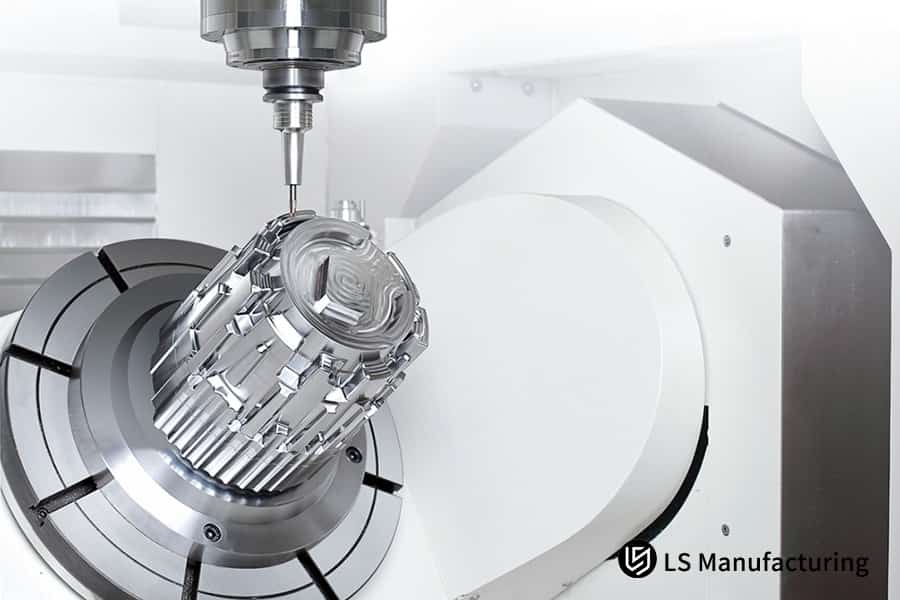
Figure 1: Evaluating CNC rapid prototyping costs for low-volume metal parts to guide partner selection.
What Exactly Constitutes The Cost Of A CNC Rapid Prototyping Quotation?
Unexpected CNC rapid prototyping costs are usually the result of unclear quotes. Here, we unravel the real structure of a CNC prototyping quote and offer a cost breakdown framework standardized across suppliers. Transparent quoting is both the first confirmation of a supplier's professionalism and a very important instrument for budget control and risk reduction in complex rapid prototyping processes.
| Cost Component | Typical Share | Key Driver & Quantifiable Example |
| Programming & Process Planning | 10-20% | Complexity dictates the number of hours: e.g., a 5-axis part might need 8 hours (¥800), but a simple 3-axis job only 2 (¥200). |
| Material Cost | 15-30% | It changes with alloy, stock size, and utilization; e.g. manufacturing a part from a Ø100mm aluminum bar can give 65% scrap, thus charging for the entire bar. |
| Machine Time | 40-50% | This is the biggest cost and is determined by the complexity of features and the machine rate (e.g., ¥350/hr for 5-axis vs ¥200/hr for 3-axis). |
| Post-Processing | Variable | Additional costs are based on operations such as sandblasting or anodizing, which are quoted as separate line items. |
| Management & QA | 10-15% | Includes first-article inspection and project coordination, a must for quality assurance in prototyping context. |
A clear cost breakdown is essential for trust - building and informed choices. Such a framework supports you in verifying the quotes by identifying whether the cost reduction is through efficient optimization or risky cost-cutting, thus bringing down your overall verification cost. Our fact-based approach offers the hard evidence needed to keep the budget under control in timely, high-value rapid prototyping cycles.

How To Reduce Prototyping Costs By 30% At The Source Through Design Optimization (DFM)?
Up to 80% of CNC rapid prototyping costs are essentially determined at the design stage. A proactive approach in design for manufacturability is the key lever to make cost-effective CNC prototyping. The following instructions show various practical, fact-based steps to cut prototype expenses by 20-30% through clever design choices:
Standardize Internal Radii
Unify all non-essential internal corners with a single standard radius (e.g., R3 or R5). This way, youll eliminate the need for special tooling, lessening the tooling and machine downtime costs due to tool changes. This single change can lower per-part cost by approximately 5%, a critical efficiency in accelerated prototyping projects.
Optimize Part Orientation for Single Setup
Arrange the features so that the majority of the machining can be done from one main orientation. Additional fixture setups cost 8-12% more and bring in the risk of cumulative alignment errors. By clever orientation, one can minimize the number of setups, save time, and even improve dimensional accuracy thus confirming the functional prototype.
Rationalize Non-Critical Tolerances
Consider the possibility of loosening significantly the tolerances on non-functional surfaces (e.g., from ±0.05mm to ±0.1mm). The resulting cutting parameters can be much more aggressive and thus faster, which can lead to a potential 20% increase in the machining efficiency without any negative aspect on the function of the part. This step is a direct answer to the question of how to control prototyping costs.
Simplify Deep Cavities & Thin Walls
Avoid pockets that are too deep to require long-reach tools and ultra-thin walls that are so thin they vibrate. Relaxing these features allows for stable, high-speed machining, it prevents tool deflection, and it also lowers the risk of scrap, thus reliability is ensured in demanding rapid prototyping.
A design for manufacturability approach is a systematic way of thinking that allows the transformation of prototypes from being cost centers to fast and reliable validation tools. Through these measures, we enable our clients to achieve a predictable budget and a quicker iteration, hence, giving them a competitive advantage in high-stakes development cycles.
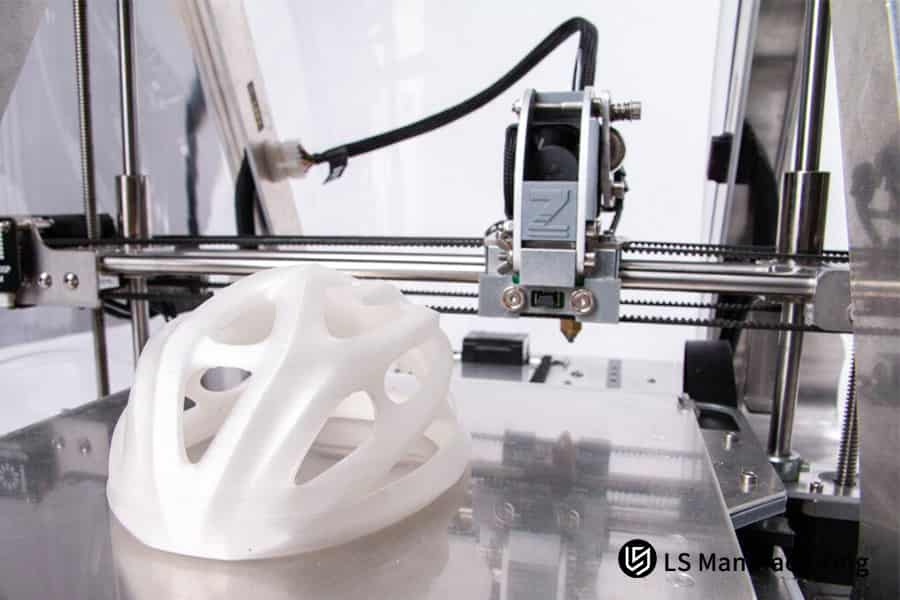
Figure 2: CNC rapid prototyping a white plastic helmet prototype for cost-effective low-volume production services.
How To Plan For Small-Batch Prototypes (1-50 Pieces) To Achieve The Optimal Unit Cost?
Low-cost prototypes for batches of 1-50 units is a classic dilemma of whether to validate the product or let the high cost per unit prevent that. Our approach is a well, planned data-oriented one that does away with the uncertainty of the process by using staged rapid prototyping, thus changing the cost landscape. A core element of this is the staged rapid prototyping method:
Strategic Cost Modeling for Decision Clarity
- Fixed vs Variable Cost Analysis: Separating setup (programming, fixtures) costs from per, unit costs.
- Non-Linear Cost Curve Mapping: Identifying specific levels of production volume (e.g., at 5 and 20 units) where significant cost-saving measures come.
- Core Objective: Creating the database that allows intelligent batch size optimization and total CNC machining cost control.
The Staged Prototyping Execution Plan
- Core Validation (1-5 units): We do low-volume CNC prototyping to test...key assumptions and simultaneously keep the initial investment low.
- Process Optimization: We take the feedback and use it to refine the designs and the machining strategies in order to achieve rapid iteration cycles.
- Extended Validation (20-30 units): We base on our processes that give reliable results in order to deepen our testing, while the amortized unit cost is significantly lowered.
Integrated Tactical Efficiencies
- Material Strategy: Materials are bought in bulk for a cheaper raw material cost and to increase the stock size.
- Production Nesting: Several parts/design variants are run at the same time so that the machine usage can be maximized.
- Result: This method allows agile prototyping and it also brings about direct unit cost reduction.
Design Synergy for Cost Reduction
- Early DFM Integration: Just by aiming at feature reduction less time is used on machining and there is less need for multiple complex setups.
- Standardization Emphasis: By concentrating on standard sizes and geometries of tools, it is possible to increase the prototyping speed and predictability
This framework presents a prototype cost optimization methodology that is quite comprehensive and definitely a step beyond just potential capabilities. We demonstrate our technological know, how through very detailed cost staging, integrated DFM, and tactical procurement that combined together can reliably, and cost, effectively, create a physical design realization line, short of executing low-volume CNC prototyping.
What Are The Effects Of Different Prototype Materials (Aluminum, Steel, Plastic) On Cost And Validation Objectives?
The choice of the prototype materials is among the main technical decisions that will greatly affect the project duration, the success of the validations, and the total money to be spent. This paper provides a material selection guide, which is based on measurable data, for the most common materials aluminum, steel, and plastic so that rapid prototyping services can work efficiently and decision, makers be better informed. The table below gives a brief, data-based comparison that can be used as a material selection guide.
| Material (Grade) | Relative Cost & Primary Characteristics | Best-Suited Validation Purpose |
| Aluminum (6061) | The baseline for the 1x price reference; it is very easy to machine and has a good strength-to-weight ratio. | Most rapid prototyping applications use the material for general form, fit, assembly checks, and light-duty functional testing. |
| POM (Acetal) | Costs a bit less than ~60% of aluminum; it offers a combination of high wear resistance and self-lubrication but has lower mechanical strength. | Functional testing of components like bearings, gears, and bushings where low friction is most essential has been thus very streamlined rapid prototyping in a very short time. |
| Stainless Steel (304) | The price is 3-4x times higher than that of aluminum, and there is a significant increase in the degree of difficulty of machining and tool wear. | Tests for structural strength under highly stressful situations or resistance to corrosion where the material's properties have to be non-negotiable. |
The basic cost-performance trade-off barely determines that one should go for the simplest material to machine which still serves the main validation purpose thereby the time and cost are directly optimized. This framework opens up a clear material choice route for an accelerated rapid prototyping by simply leaving out the costly over-engineering. The technical level of the framework provides high-value, competitive situation development guidance from a strong authoritative standpoint.
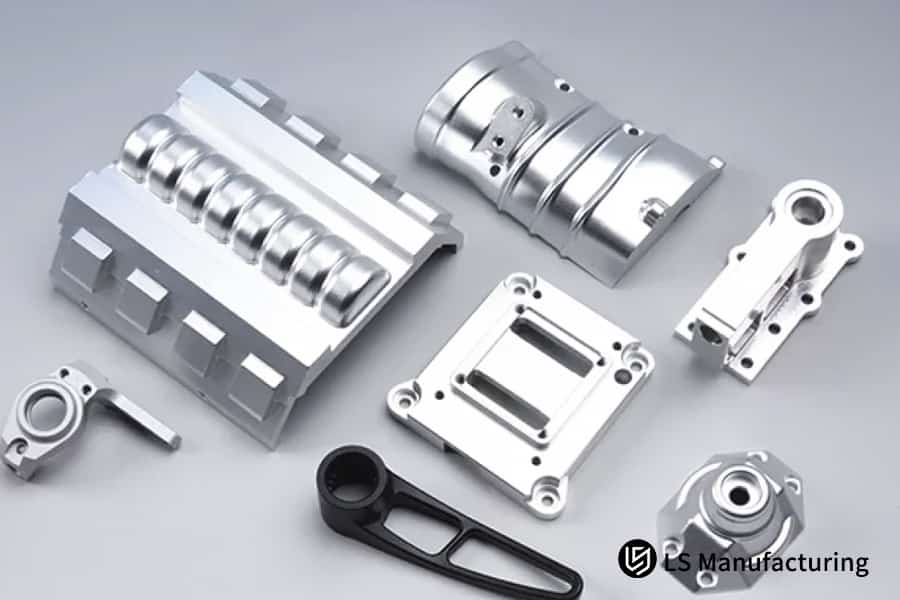
Figure 3: Displaying precision metal rapid prototype parts for low-volume manufacturing and cost control analysis.
What Are The Key Technical Metrics To Focus On When Evaluating CNC Rapid Prototyping Suppliers?
Choosing a CNC prototyping partner means looking into the technical workflows deeply, not just the machines in order to ensure the delivery of dimensionally perfect parts on time. This article illustrates the essential supplier technical evaluation criteria that enable the risk of the program to be minimized by prevalidation:
Rapid Feasibility Analysis & Process Commitment
We eradicate the timeline uncertainty problem with a rigorous 4-hours response standard. On receiving your CAD file, our production engineers will carry out a manufacturability evaluation and within the given period, they will opt for the most streamlined rapid prototyping process plan thus allowing the project to be kicked off that day and the technical knowledge to be cleared up.
Virtual Verification via CAM Simulation
We employ advanced CAM software for simulations of the entire machining sequence to ensure no physical errors are made. The virtual dry, run helps us find and correct any toolpath collisions, workpiece interference, and inaccurate feeds/speeds prior to cutting the metal, thereby resulting in an error-free rapid prototyping base while at the same time, your material and schedule are safe from being compromised.
In-Process Metrology for Certified Components
We back up our first-article conforming assurance by incorporating on-machine probing. With this technology, dimension measurement can be carried out at any time during the process and without additional worker intervention, also tool wear compensation is automatically done thus first-part success rates are consistently pushed beyond 95%. The advantage provided by our precision rapid prototyping capability can be seen clearly on complex parts of high value, where the possibility of rework is not only expensive but also where such reworks can lead to the delay of the whole program.
This guide on how to choose a CNC prototyping partner helps to resolve the fundamental problem of getting a certifiable part accurate on the first try. Our agile rapid prototyping technique backed by these technical bases, gives the client the certainty of schedules and costs, thus setting our mission-critical development service apart where trustworthiness is a must.
LS Manufacturing Medical Device Industry: Endoscope Handpiece Multi-Round Iteration Prototype Cost Control Project
This LS Manufacturing medical prototype case follows a multi-iteration project in which the strategic selection of materials and design-for-manufacturability (DFM) interventions helped a medical device startup overcome significant budget and timeline pressures. It is a story of how a cost control success was achieved:
Client Challenge
Five design iterations were needed for a single-use endoscope handle being developed by a startup. It was found that the first SLA prototypes could not pass the IPX7 sealing test. Hence, the CNC prototypes were needed. The quotes for medical, grade PEEK came to over ¥8, 000 a unit for the small batches, which was a bottleneck for the agile rapid prototyping phase and was threatening the entire development budget and schedule.
LS Manufacturing Solution
Our proposal was built on two main aspects. Firstly, we advised swapping the main raw material to machinable medical-grade PP for the first three assembly and ergonomic testing cycles, thus slashing the cost of raw material by 60%. Secondly, we came up with a two-piece design for the intricate, monolithic outer casing, that aside from drastically simplifying 5-axis CNC machining, also reduced cutting labor hours. We set up a fixed-price, five-iteration agreement for streamlined rapid prototyping and budgeting with no surprises.
Results and Value
The customer was able to carry out all five functional testing rounds at an average cost of less than ¥3, 500 per iteration and thus, the overall project cost was lower than their initial single-iteration quotation. This precision rapid prototyping method shortened the development schedule by 6 weeks, which in turn, led to quicker regulatory submission and demonstrated that intelligent process design is the keystone of medical device innovation.
This LS Manufacturing medical prototype case is a demonstration of how thorough technical collaboration and DFM proficiency can be the cure for the problem of conducting necessary, iterative testing under stringent budget constraints. Our offering goes beyond giving you parts as we are a reliable rapid prototyping partner that helps you turn costly development hurdles into easy-methodical processes in both competitive and highly regulated industries.
Struggling with runaway costs from multiple prototype iterations? Get our optimized strategy to stay on budget.

How To Identify And Avoid Hidden Fees And Potential Risks In A Quote?
One of the main reasons for budget overruns and legal exposure in rapid prototyping projects is unclear quotations and undefined terms. A systematic supplier risk assessment is necessary not only to supplier risk assessment but also to safeguard intellectual property. This manual explains a step, by, step approach to turning a CNC prototyping quote into a detailed risk, mitigation instrument:
Scope-Locked, Line-Item Transparency
- Explicit Inclusions: Our CNC prototyping quote specifies all operations involved: machining, standard finishes, and FAI report.
- Formal Change Control: A change without a signed change order and a new quotation is not possible, thus ensuring cost-certain rapid prototyping.
Justified and Tiered Expedite Fees
- Pre-Defined Surcharge Schedule: We list clear markups (e.g., +50% for 3-day) reflecting actual production re-sequencing costs.
- Informed Client Decisions: This makes it possible for the client to clearly see the consequences of the decision in terms of speed and budget during the agile rapid prototyping.
Integrated Intellectual Property Protection
- Quote-as-Contract Framework: Key terms such as a mutual NDA and IP ownership clauses are included in our official quotation.
- Proactive Security: This basic step in supplier risk assessment safeguards your design confidentiality as a matter of course.
This methodical way basically addresses the major challenge of uncontrolled costs and legal ambiguity in rapid prototyping projects. Our focus is on predictable partnerships that are our customers, by us providing binding clarity upfront on deliverables, costs, and protections, which is a must for handling high-value, iterative development with strict compliance and stakeholder requirements.
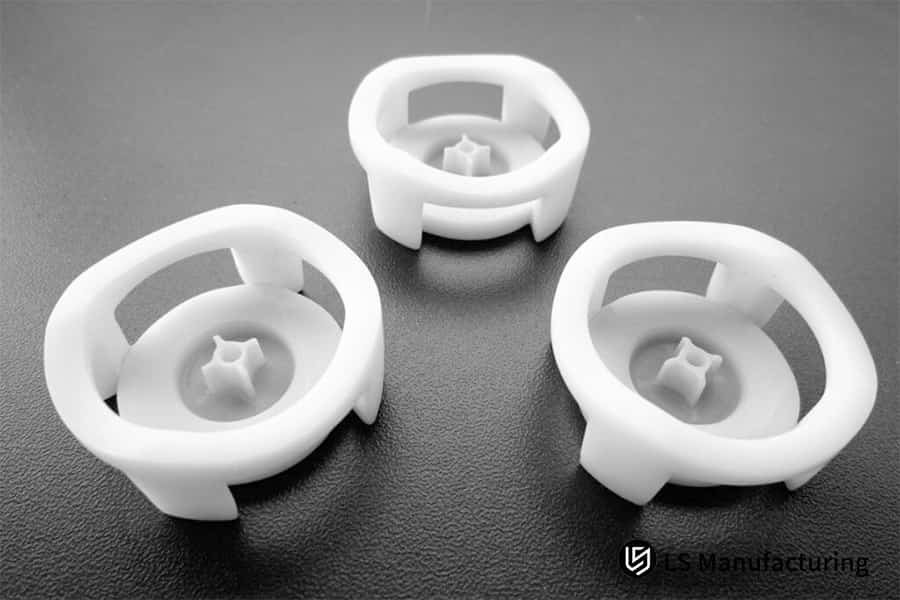
Figure 4: Displaying white plastic rapid prototype components for low-volume production and cost-effective partner selection.
Why Can LS Manufacturing's "Engineering Partner" Model Reduce Your Total Validation Costs?
Traditional supplier relationships often focus on transactional efficiency, rather than optimizing the total financial outcome of your project. In contrast, LS Manufacturing is an engineering partnership that walks alongside your development cycle to proactively reduce your total verification cost through the sharing of expertise and aligned incentives. The core differentiators are:
Knowledge Base Reuse: Leveraging Cross-Industry Solutions
We deal with the recurrent engineering issues by changing the solutions which are proven and are a part of our project library to different industries. For example, a custom fixturing strategy developed for a robotic arm assembly, after sanitization, was directly applied to a medical device client's similar housing, which saved design and fabrication costs of ¥15, 000 and additionally, their streamlined rapid prototyping phase was accelerated by one week.
Predictive DFM Guidance: Preventing Errors Before Machining
We add value by intervening before the cost is incurred. Looking at your CAD model together with a project database, we are able to pick out features that are most likely to cause trouble (e.g. thin walls, deep pockets with standard tools) and then we offer you precise, design changes, based on data, before programming. This precision rapid prototyping technique not only reduces the possibilities of rejection and rebuilds but also ensures that the first sample will be fit for testing.
Transparent Total-Cost Optimization
Our commercial model is in line with your success. Rather than maximizing margin per order, we at LS Manufacturing focus on minimizing your total project expenditure (component cost + delay cost). It may be a matter of us suggesting a cheaper material for the early iterative rapid prototyping rounds or us deciding to drop a design feature that will save 8 hours of machining, with all trade-offs and savings clearly quantified for your approval.
This engineering partnership model, with a focus on total verification cost, is one of the main factors why choose LS Manufacturing for complex developments. We address the systemic problem of prototyping overspending by embedding expert preventions and a cost-transparent collaboration into your work system, thus allowing us to become your strategic asset for high-stakes and long-term innovation programs.
FAQs
1. What is the fastest lead time for a CNC rapid prototype?
We have a 48, hour delivery channel for simple parts. However, when it comes to expedited delivery, additional costs may be incurred, which we will notify you of beforehand.
2. Which 3D file formats do you support? Are there any file size limits?
We support main stream file formats such as STEP, IGES, SLDPRT and X_T. We suggest you upload the file in STEP format for accuracy. The size of the file is recommended to be under 100MB; bigger files can be transferred separately through your account manager.
3. If a design error is found after the prototype is completed, will the cost of a revised quote be high?
It really depends on how big the changes are. If there are only a few small changes and there will be no new tooling, usually the cost will be just for reprogramming and machining. We will give you a clear and transparent cost comparison before and after the modification.
4. What is the relationship between the price of a small batch prototype (e.g., 10 pieces) and the price of mass production?
The unit price of a prototype is normally 2-5 times more expensive than the unit price of an order, mainly because the one-time costs such as programming and fixtures are spread over production quantities. We can help you with tiered pricing from prototype to small batch production so you can plan your budget.
5. How can I ensure my designs and ideas are not leaked or copied?
At first, a non-disclosure agreement (NDA) has to be signed before starting a cooperation. We use a project, isolated data management system internally to protect our clients' data and our staff goes through intensive confidentiality training.
6. Do you provide post-processing (such as painting, screen printing) and assembly services for prototypes?
We offer you a fully integrated service that locates everything you need in one place from sandblasting, anodizing, painting, screen printing to even simple assembly so that the product you demo or test will be perfectly finished.
7. Can you provide advice on which process to use for parts?
Sure, we freely give manufacturing process consultation by analyzing machining CNC, 3D printing (metal/plastic), vacuum casting, etc. from the perspectives of costs, lead times and performance differences so that you can choose the option that suits you best.
8. How can I start my first prototype project and get an accurate quote?
Just head to the "Get a Quote" section of the LS Manufacturing website, upload your 3D files, and tick the boxes of your basic requirements (materials, quantity, surface treatment). Our technical team will begin working on your case and send you a complete quotation within two business hours.
Summary
Effectively controlling CNC rapid prototyping costs is a systematic project that integrates design optimization, scientific planning, and supplier management. It requires you to go beyond simple price comparisons, deeply understand cost drivers, and choose a professional partner who can provide transparent data, engineering insights, and share the risks of validation. By implementing the framework and strategies presented in this article, you can transform prototyping-stage spending from uncontrollable "consumption" into efficient and predictable "investment," accelerating your product launch.
Upload your part drawings now and receive a customized "Rapid Prototyping Manufacturing Cost Optimization and Feasibility Analysis Report" by LS Manufacturing engineers. This free report will provide you with: 1) a quantitative analysis of potential cost spikes and optimization suggestions in the design; 2) precise quote ranges based on real project data; and 3) a clear cost evolution path from prototype to small batch. Take the first step and replace cost anxiety with professional planning.
Take control of your prototyping budget and timeline with our cost-optimized CNC solutions.
📞Tel: +86 185 6675 9667
📧Email: info@lsrpf.com
🌐Website: https://lsrpf.com/
Disclaimer
The contents of this page are for informational purposes only. LS Manufacturing services There are no representations or warranties, express or implied, as to the accuracy, completeness or validity of the information. It should not be inferred that a third-party supplier or manufacturer will provide performance parameters, geometric tolerances, specific design characteristics, material quality and type or workmanship through the LS Manufacturing network. It's the buyer's responsibility. Require parts quotation Identify specific requirements for these sections.Please contact us for more information.
LS Manufacturing Team
LS Manufacturing is an industry-leading company. Focus on custom manufacturing solutions. We have over 20 years of experience with over 5,000 customers, and we focus on high precision CNC machining, Sheet metal manufacturing, 3D printing, Injection molding. Metal stamping,and other one-stop manufacturing services.
Our factory is equipped with over 100 state-of-the-art 5-axis machining centers, ISO 9001:2015 certified. We provide fast, efficient and high-quality manufacturing solutions to customers in more than 150 countries around the world. Whether it is small volume production or large-scale customization, we can meet your needs with the fastest delivery within 24 hours. choose LS Manufacturing. This means selection efficiency, quality and professionalism.
To learn more, visit our website:www.lsrpf.com.